On this page
A Golden Retriever Bernese Mountain Dog mix, often called a Golden Mountain Dog, is a cross between two large, people-oriented breeds. A full-grown dog may be substantial, heavily coated, affectionate, and trainable, but there is no official mixed-breed standard that guarantees one adult size, color, temperament, or lifespan.
If you are considering a puppy, the safest planning assumption is a large adult dog with a double coat, regular shedding, daily exercise needs, and health risks that can come from either parent breed. The most useful clues are the actual parents—their size, temperament, health testing, and family history—not a designer-breed label.
Key Takeaways
- Golden Mountain Dog is a common informal name for a Golden Retriever and Bernese Mountain Dog mix.
- A full-grown dog is usually large, but no responsible breeder can guarantee an exact adult weight from the mix name alone.
- Golden Retrievers are typically 55–75 pounds and Bernese Mountain Dogs 70–115 pounds, so the parent breeds create a broad size envelope.
- Expect a double coat and regular shedding. This is not a reliably low-shedding or hypoallergenic cross.
- Temperament may combine Golden sociability and enthusiasm with Bernese affection and a somewhat calmer style, but individuals vary.
- Health testing should address the recommended screening for both parent breeds rather than relying on “hybrid vigor.”
- The cross has no authoritative breed-specific lifespan; parent-breed references are more honest than a made-up average.
What is a Golden Retriever Bernese Mountain Dog mix?
It is a dog with Golden Retriever and Bernese Mountain Dog ancestry. In a first-generation, or F1, cross, one parent is a Golden Retriever and the other is a Bernese Mountain Dog. Later-generation dogs may have a more complicated family tree.
Other names you may see include:
- Golden Mountain Dog
- Golden Bernese
- Bernese Golden mix
- Berner Golden mix
- half Golden Retriever half Bernese Mountain Dog
These names are descriptions rather than a formal breed standard. Two puppies sold under the same name can mature quite differently.
Full-grown Golden Mountain Dog size
The parent breeds give a realistic starting point.
| Trait | Golden Retriever | Bernese Mountain Dog | What it means for the mix |
|---|---|---|---|
| Adult weight | 55–75 lb | 70–115 lb | Plan for a large dog; exact weight is unpredictable |
| Adult height | 21.5–24 in | 23–27.5 in | Many mixes are tall and substantial |
| Build | Athletic sporting dog | Heavier working dog | A mix may be leaner, stockier, or intermediate |
| Coat | Medium double coat | Thick moderately long double coat | Regular shedding is highly likely |
| Parent-breed life expectancy | 10–12 years | 7–10 years | Do not simply average these into a guaranteed mix lifespan |
A puppy does not inherit the mathematical midpoint of every trait. One littermate may mature with a heavier Bernese-like frame while another looks more like a tall Golden Retriever.
If your home, vehicle, airline crate, lease, or lifestyle has a strict weight limit, this cross is not a good choice when adult size must be predictable.
When is a Golden Mountain Dog full grown?
Large dogs usually gain most of their height before they finish filling out through the chest and body. A Golden Mountain Dog may look tall and lanky during adolescence and continue adding muscle and mature body condition after height growth slows.
There is no single month when every dog in this cross is “finished.” Growth depends on:
- genetics
- sex
- the size of both parents
- nutrition
- body condition
- health
- whether the puppy develops more Golden-like or Bernese-like structure
Avoid trying to make a puppy grow faster by overfeeding. Rapid excess weight gain adds stress to developing joints. Ask your veterinarian whether a large-breed puppy food and controlled growth plan are appropriate for your individual puppy.
How can you estimate a puppy’s adult size?
No method is perfect, but some clues are better than internet formulas.
Look at both parents
The verified adult weight and height of the mother and father are more useful than the mix name. If both parents are at the larger end of their breed ranges, a very small adult outcome is less likely.
Look at the family, not just one dog
Ask about adult sizes from previous litters using the same lines. Siblings, grandparents, and earlier offspring can reveal how much variation appears in the family.
Use growth trends, not paw size myths
Large paws can accompany a large puppy, but paw size alone is not a reliable adult-weight calculator. Your veterinarian can track growth and body condition over repeated visits.
What does a half Golden Retriever half Bernese Mountain Dog look like?
Appearance can vary even within one litter.
Possible features include:
- black, gold, cream, rust, white, or mixed coloring
- a Bernese-style white blaze or chest marking
- Golden-like feathering
- drop ears
- a broad or moderately broad head
- a heavy Bernese-like frame
- a lighter sporting-dog build
- straight or slightly wavy coat texture
- a thick tail with feathering
Some puppies look unmistakably like a blend of the two breeds. Others can resemble one parent strongly.
Do not choose a breeder primarily because they promise a rare color or a perfect tricolor pattern. Cosmetic predictability matters far less than stable temperament, health screening, sound structure, and responsible puppy raising.
Golden Mountain Dog temperament
Both parent breeds were developed to work with people, but they were selected for different jobs.
Golden Retrievers are sporting dogs known for retrieving, enthusiasm, trainability, and social behavior. Bernese Mountain Dogs are large Swiss working dogs historically used around farms and for draft work, and are commonly described as calm, affectionate, and sensitive.
A mix may be:
- affectionate with family
- friendly with visitors
- eager to learn
- playful and enthusiastic
- calmer indoors after exercise
- sensitive to harsh handling
- highly food- or toy-motivated
- more reserved with strangers than a typical Golden
No crossbred label guarantees a personality. Genetics, prenatal conditions, early handling, socialization, training, pain, health, and life experience all influence behavior.
Are Golden Mountain Dogs good family dogs?
They can be excellent family companions when their size and needs fit the household.
A large, friendly adolescent can still knock over a small child. Supervision and training matter even when aggression is not a concern.
Useful skills include:
- four paws on the floor for greetings
- loose-leash walking
- recall
- leave it
- drop it
- settling on a mat
- calm behavior around doors
- comfortable handling for grooming
Children should also learn to leave dogs alone while they eat, sleep, or retreat to a quiet space.
Exercise needs
Most healthy adults need daily activity plus mental engagement.
Good options may include:
- neighborhood walks
- hiking in suitable weather
- retrieving games
- swimming if the dog enjoys it
- scent games
- obedience or rally
- food puzzles
- structured play
The Golden side may contribute sustained enthusiasm and retrieving drive. The Bernese side may contribute a heavier body and lower tolerance for heat.
Avoid hard repetitive exercise in growing puppies until your veterinarian says their developmental stage is appropriate.
Heat tolerance and weather
Both parent breeds have double coats, and the Bernese Mountain Dog is particularly adapted to cooler conditions. A thick-coated, large mix can become uncomfortable quickly in hot weather.
During heat:
- exercise early or late in the day
- keep fresh water available
- provide air-conditioned or cool indoor rest
- avoid hot pavement
- shorten intense activity
- watch for excessive panting, weakness, disorientation, or collapse
Never leave a dog in a hot vehicle.
Training a Golden Bernese mix
Start before the puppy becomes physically powerful.
Priorities include:
- recall
- loose-leash walking
- calm greetings
- leave-it and drop-it
- comfortable crate or pen time
- grooming cooperation
- nail and paw handling
- waiting at doors
- settling around visitors
- being comfortable alone for reasonable periods
Short reward-based sessions are usually more productive than harsh corrections. Both parent breeds can be very people-oriented, and Bernese Mountain Dogs are often sensitive to rough handling.
Seek qualified behavioral help early if you see persistent fear, guarding, reactivity, or severe separation distress.
Grooming: how much does a Golden Mountain Dog shed?
Expect hair.
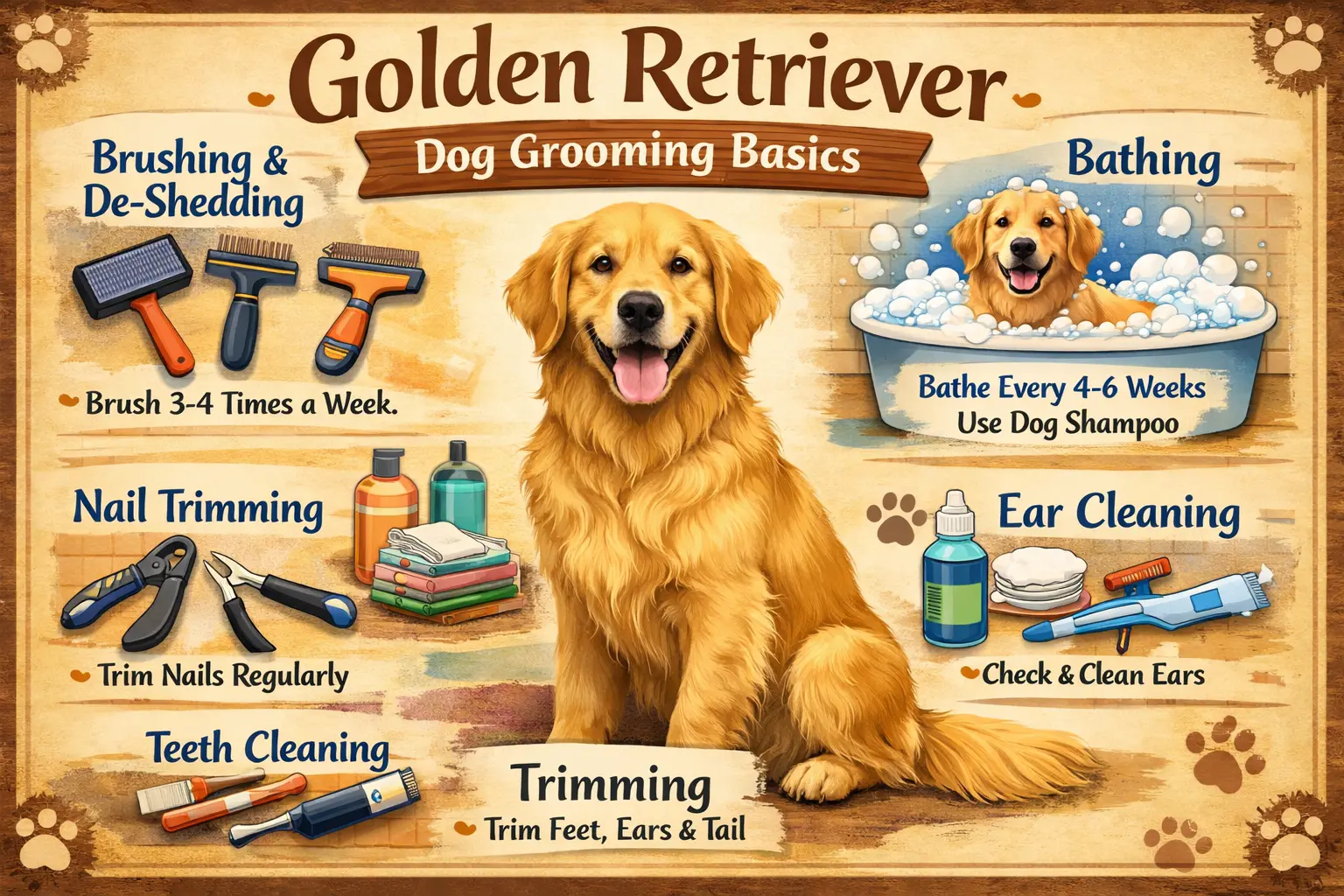
Both parents have double coats. Most mixes benefit from brushing several times a week and more often during seasonal shedding.
Pay particular attention to:
- behind the ears
- chest feathering
- armpits
- tail
- backs of the legs
- areas under collars or harnesses
Regular care also includes nail trimming, dental care, ear checks, and bathing when needed. Professional grooming can help with bathing, drying, and undercoat removal, but it will not turn this into a low-shedding dog.
Health testing matters more than “hybrid vigor”
Crossbreeding can increase genetic diversity, but it does not make a puppy immune to inherited disease.
Golden Retriever breeding programs commonly screen hips, elbows, eyes, and heart. Bernese Mountain Dog programs also emphasize hips, elbows, eyes, heart, and breed-relevant DNA and family-history information.
Before paying a deposit, ask:
- What specific health tests were completed on the Golden parent?
- What specific tests were completed on the Bernese parent?
- Can I independently verify the results?
- What cancers or serious diseases occurred in close relatives?
- How old were grandparents and other close relatives when they died?
- Are both parents old enough for final orthopedic clearances where required?
- What happens if the puppy develops a hereditary problem?
“Vet checked” is not the same as a complete breeding-health screening program.
Golden Mountain Dog lifespan
There is no robust population dataset that supports one exact lifespan for this cross.
The American Kennel Club lists Golden Retrievers at about 10–12 years and Bernese Mountain Dogs at about 7–10 years. A mixed dog’s lifespan may fall within, below, or above those parent-breed references.
Longevity is influenced by factors including:
- inherited disease risk
- cancer
- adult body size
- healthy weight maintenance
- orthopedic health
- preventive veterinary care
- dental health
- accidents and environment
For a dog you already own, age should be considered alongside body condition and health rather than as a simple countdown. You can check your dog’s age in human-year terms for additional life-stage context, while remembering that size and individual health still matter.
Feeding a large mixed-breed dog
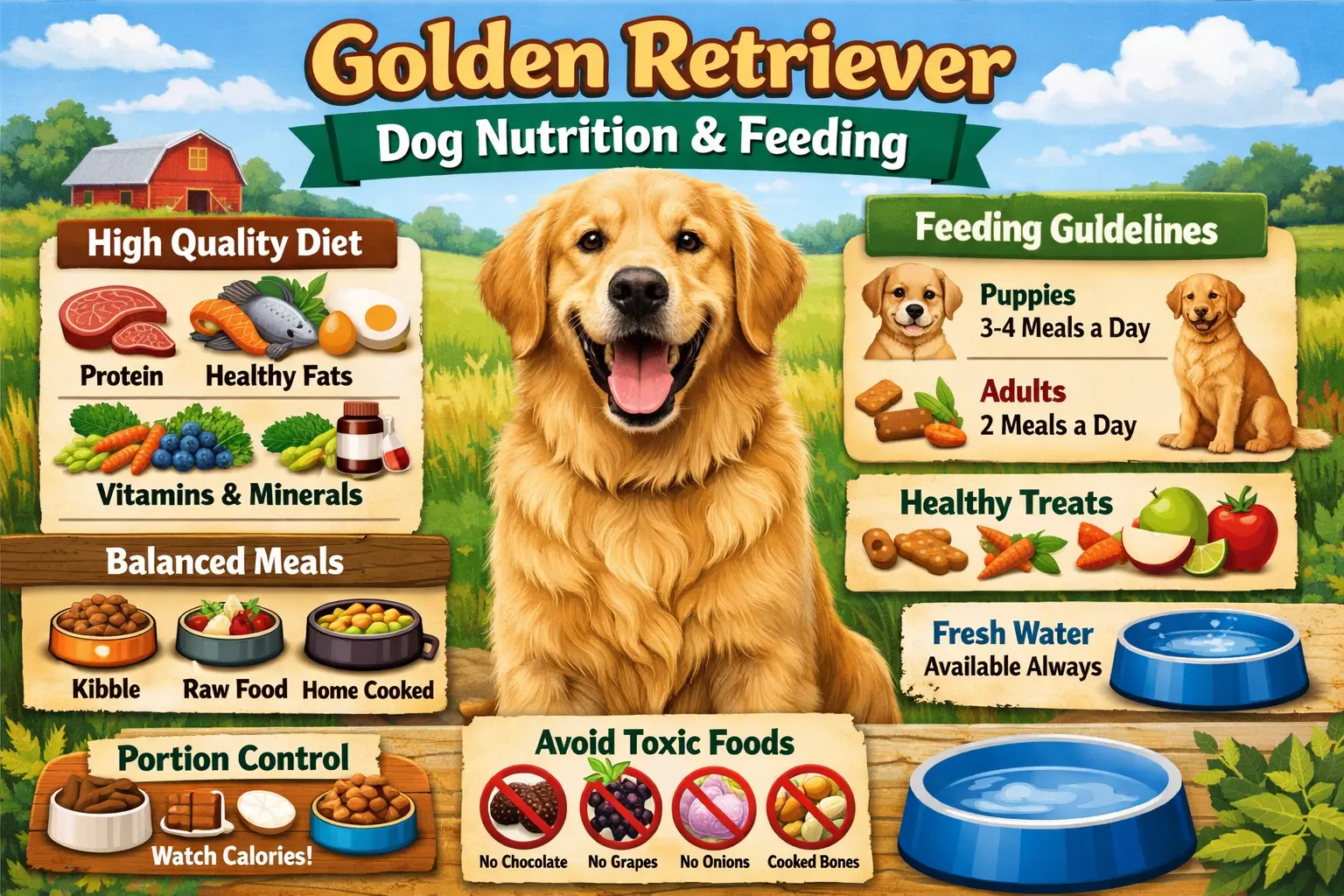
Feed a complete diet appropriate for life stage and expected adult size. Growing large-breed puppies benefit from controlled, steady growth rather than excess calories.
For adults:
- measure meals rather than free-feeding
- count treats toward daily calories
- monitor waist and rib coverage
- adjust portions when activity changes
- discuss unexpected weight gain or loss with a veterinarian
A healthy body condition is more useful than trying to make a dog match an internet weight chart.
Costs to plan for
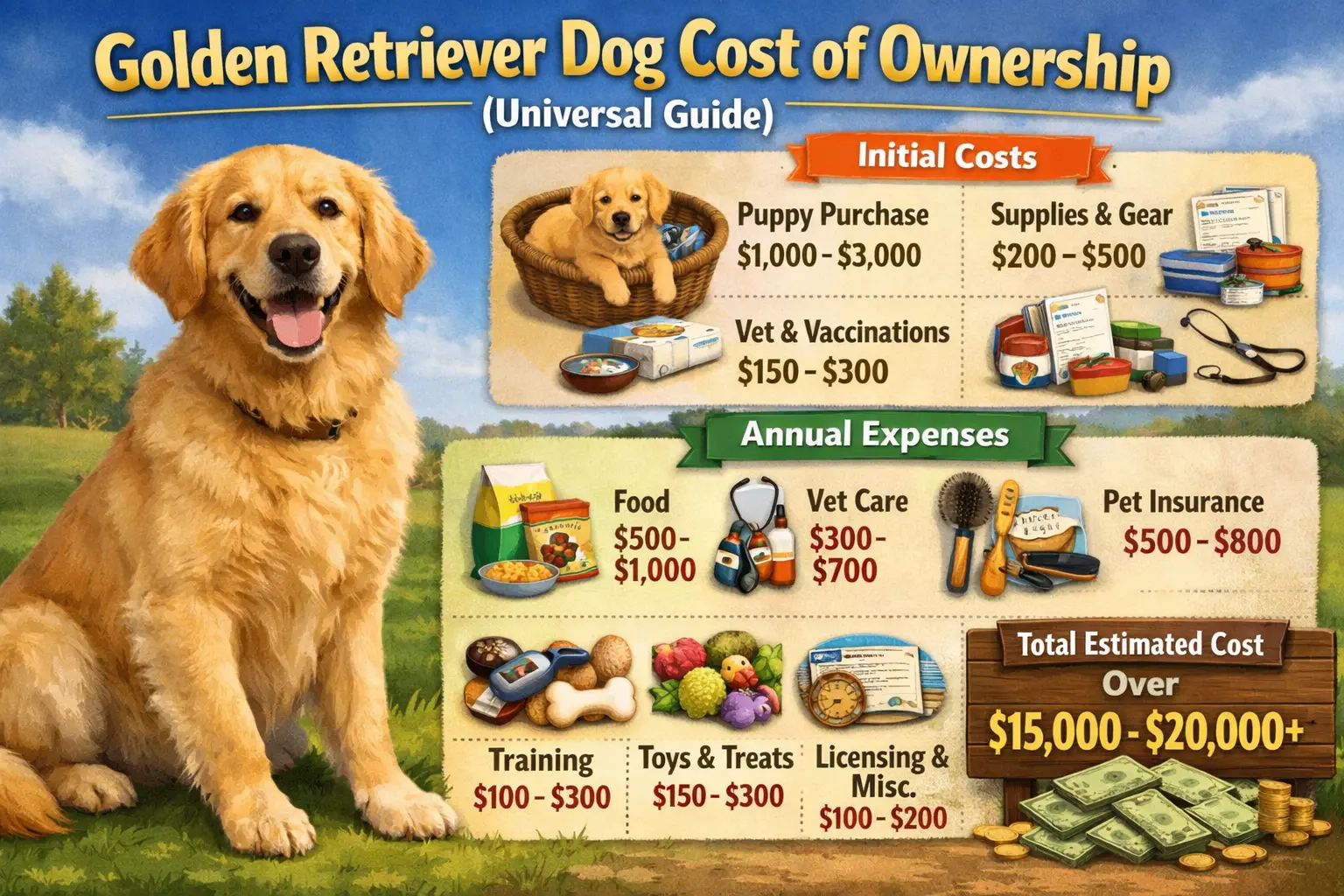
A large dog can cost more than owners expect.
Budget for:
- large-breed food
- parasite prevention based on body weight
- larger medication doses
- durable beds and crates
- training
- grooming tools or professional grooming
- boarding or pet sitting
- routine veterinary care
- orthopedic diagnostics if needed
- emergency care
The purchase price is only one part of lifetime ownership.
Is this mix right for you?
A Golden Retriever Bernese Mountain Dog mix may suit you if you want a large, interactive companion and can accept variation.
It may be a strong fit if you:
- enjoy daily walks and training
- can tolerate shedding
- have time for grooming
- can manage a large adolescent dog
- want a family-involved companion
- can afford large-dog care
- are comfortable with uncertain adult color and size
It may be a poor fit if you need a low-shedding coat, minimal daily activity, a reliably small adult dog, or a dog that spends long periods alone every day.
What to ask before buying a Golden Mountain Dog puppy
Ask more than “How much?” and “What color will it be?”
A responsible conversation should cover:
- why the pairing was chosen
- verified health testing
- parent temperaments
- family longevity
- puppy socialization
- where puppies are raised
- vaccination and veterinary records
- contract terms
- return policy
- support after purchase
A breeder who makes absolute promises about adult size, health, lifespan, or temperament is offering certainty that genetics cannot provide.
Frequently asked questions
How big is a full-grown Golden Mountain Dog?
There is no fixed mixed-breed standard. The parent breeds span roughly 55–115 pounds and 21.5–27.5 inches at the shoulder, so owners should prepare for a large adult rather than depend on a promised midpoint.
Is a Golden Retriever Bernese Mountain Dog mix the same as a Golden Mountain Dog?
Usually, yes. Golden Mountain Dog is a common informal name for the cross, but verify the actual parentage when buying or adopting.
Do Golden Mountain Dogs shed a lot?
Many do. Both parent breeds have double coats, so regular brushing and seasonal shedding should be expected.
Are Golden Mountain Dogs good with children?
They can be, but individual temperament and training matter. Large dogs should always be supervised around young children.
Are Golden Mountain Dogs hypoallergenic?
No. This cross should not be marketed as reliably hypoallergenic or low-shedding.
How long does a Golden Retriever Bernese Mountain Dog mix live?
There is no authoritative breed-specific figure. Parent-breed life expectancy is about 10–12 years for Golden Retrievers and 7–10 years for Bernese Mountain Dogs, but a mix cannot be assigned a guaranteed average by simple arithmetic.
What health tests should a breeder show?
Ask for verifiable screening recommended for both parent breeds, including orthopedic, eye, and cardiac evaluations plus applicable breed-specific testing and family health history.
A note on sources and method
Parent-breed measurements, lifespan, coat, and general breed characteristics were checked against current American Kennel Club information. Health-screening guidance is based on parent-breed club recommendations. Because this cross has no standardized registry population, this article treats adult size, appearance, temperament, and lifespan as ranges and planning considerations rather than guaranteed mixed-breed traits. No individual veterinarian reviewed this draft.

Ata Ur Rehman is the founder of Pet Age in Human Years Calculator, an educational platform that provides age conversion charts and lifespan guides for dogs, cats, birds, and other companion animals. His work focuses on helping pet owners understand how animal ages translate into human years using commonly accepted age conversion formulas and published lifespan averages.
The website compiles breed and species lifespan data from kennel clubs, breed organizations, and general animal lifespan studies to present simple and easy-to-understand guides for pet owners worldwide.
This website was created to centralize animal age conversion charts into one easy reference platform for pet owners.
This article is for general education. For symptoms, medication, diet changes, or health concerns, use a qualified veterinarian who can assess your individual pet.