On this page
A Norwich Terrier may be small, but feeding this breed correctly takes more than guessing a cup size. Norwich Terriers are active, food-motivated dogs with compact bodies, steady energy needs, and a real risk of weight gain when portions are not measured carefully.
This Norwich Terrier feeding guide explains what to feed a Norwich Terrier, how much food they need per day, which food types work best, and how to adjust meals for puppies, adults, seniors, and less active dogs.
A healthy Norwich Terrier diet should help support:
- Steady daily energy without unnecessary weight gain
- Healthy skin and a wiry coat
- Firm stools and smoother digestion
- Lean muscle and joint support as they age
- Better long-term health through controlled portions
Because Norwich Terriers are small dogs, even small feeding mistakes matter. A few extra treats, oversized portions, or free-feeding can slowly lead to obesity, which puts pressure on the joints, heart, and internal organs.
Many Norwich Terrier owners also notice common feeding issues such as constant hunger, fast eating, picky eating, weight gain, or digestive upset after switching foods. Most of these problems are connected to portion control, food quality, feeding schedule, and life-stage needs.
If you also want to understand how your dog’s age affects feeding, activity, and care needs, use the Norwich Terrier Dog Age Calculator alongside this guide.
Quick Answer: Norwich Terrier Feeding Guide
An adult Norwich Terrier usually needs about 300 to 450 calories per day, split into two measured meals. This often equals around ½ to 1 cup of dry food per day, depending on the food’s calories per cup, your dog’s weight, activity level, age, and body condition.
| Feeding Question | Quick Answer |
|---|---|
| How often should adults eat? | 2 measured meals per day |
| How often should puppies eat? | 3-4 smaller meals per day |
| How many calories per day? | About 300-450 calories for most adults |
| How much dry food per day? | About ½ to 1 cup, depending on calories per cup |
| Best food type? | Complete small-breed food with quality protein and controlled calories |
Use these numbers as a starting point, not a fixed rule. A Norwich Terrier that is older, less active, neutered, or gaining weight may need the lower end of the range.
What to Feed a Norwich Terrier: Core Nutrition Needs
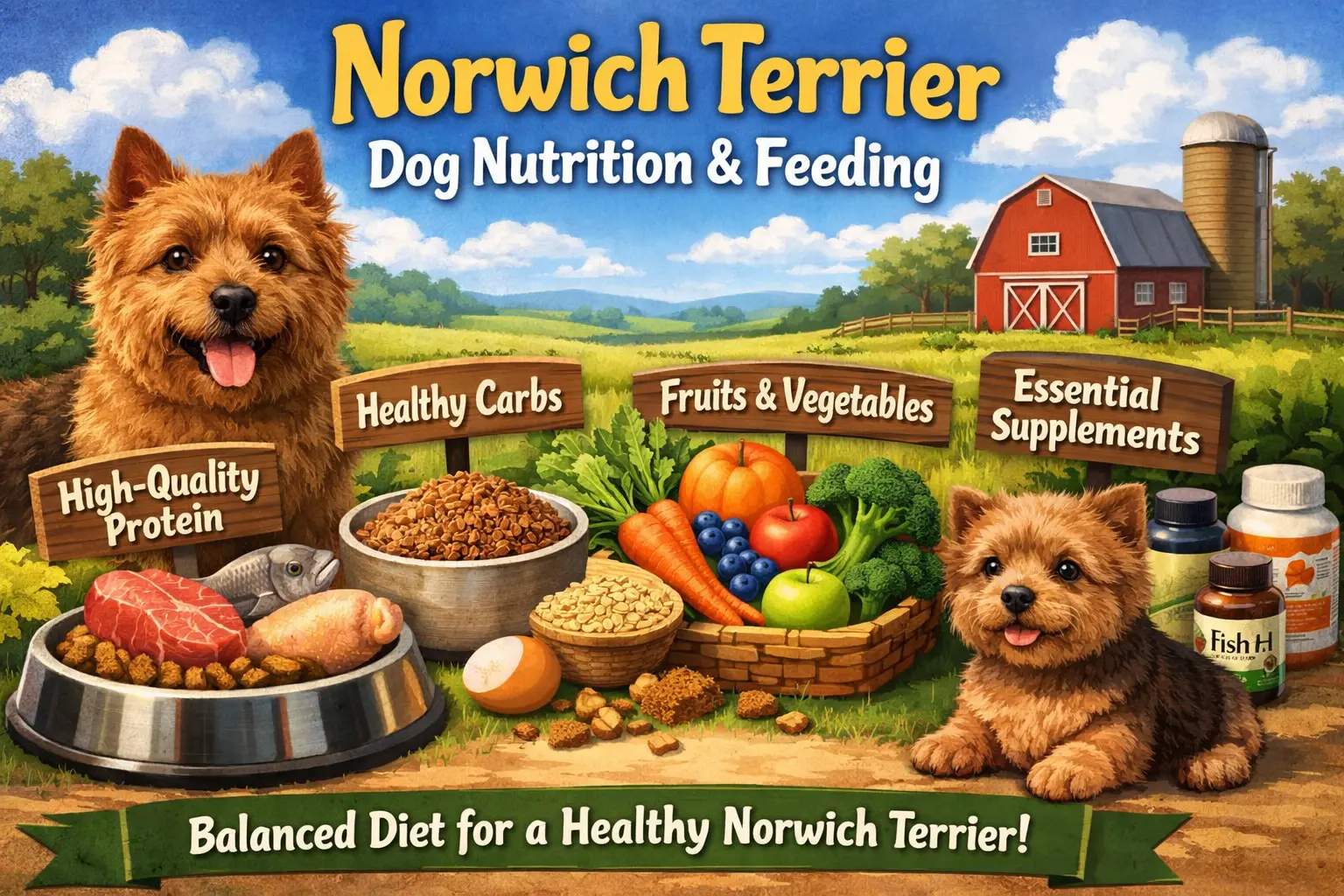
A Norwich Terrier does best on a balanced, high-quality small-breed diet. The food should be nutrient-dense enough to support energy, but not so calorie-heavy that it causes weight gain. The best dog food for Norwich Terriers is usually a complete and balanced formula with quality animal protein, moderate fat, digestible carbohydrates, and controlled calories.
Before choosing food, focus on these core nutrition needs.
Protein for lean muscle and energy
Protein helps a Norwich Terrier maintain lean muscle, support skin and coat health, and stay active throughout the day. Look for dog food where a named animal protein such as chicken, turkey, lamb, beef, or fish appears near the top of the ingredient list.
Moderate fat for energy and coat health
Fat supports energy, skin, and coat condition, but too much fat can quickly increase calories. Norwich Terriers usually do better with moderate-fat food rather than rich, high-fat formulas designed for large working dogs.
Digestible carbohydrates and fiber
Carbohydrates can provide steady energy, while fiber helps stool quality and digestion. Good carbohydrate and fiber sources may include brown rice, oats, sweet potatoes, pumpkin, and other digestible ingredients. Foods with too many low-quality fillers may cause gas, loose stool, or inconsistent digestion.
Vitamins and minerals for complete nutrition
A complete dog food should provide the vitamins and minerals needed for immune health, bone support, nerve function, and muscle function. Avoid relying on homemade meals as the full diet unless they are properly balanced for dogs.
Ideal nutrient ranges for Norwich Terriers
| Nutrient | Suggested Range | Why It Matters |
|---|---|---|
| Protein | 22-30% | Supports lean muscle, energy, skin, and coat |
| Fat | 10-18% | Provides energy without excessive calories |
| Fiber | 3-6% | Supports digestion and stool quality |
| Calories | Controlled small-breed density | Helps prevent overfeeding in small portions |
These ranges are general guidelines. Your Norwich Terrier’s age, weight, activity level, body condition, and health history should always guide the final feeding amount.
Grain-free vs grain-inclusive food
Most Norwich Terriers do not need grain-free food unless a veterinarian has identified a specific sensitivity. Many grain-inclusive diets are suitable when they use digestible grains and meet complete-and-balanced nutrition standards.
Quick label checklist
- Choose food labeled complete and balanced for your dog’s life stage
- Look for a named animal protein source
- Avoid formulas that rely heavily on vague ingredients or unnecessary fillers
- Check calories per cup, can, or serving before deciding portions
- Choose small-breed kibble size if your Norwich Terrier struggles with larger pieces
How Much to Feed a Norwich Terrier Per Day
Most adult Norwich Terriers need about 300 to 450 calories per day, depending on their weight, age, activity level, and body condition. Very active dogs may need more, while seniors, indoor dogs, and dogs gaining weight may need less.
The best answer to “how much to feed a Norwich Terrier” is based on calories first, then cups or grams second. Different foods have different calorie densities, so one brand’s ½ cup may not equal another brand’s ½ cup.
Daily calorie guide for adult Norwich Terriers
| Weight | Low Activity | Moderate Activity | High Activity |
|---|---|---|---|
| 10 lbs / 4.5 kg | About 300 calories | About 350 calories | About 400 calories |
| 12 lbs / 5.5 kg | About 330 calories | About 380 calories | About 430 calories |
| 14 lbs / 6.5 kg | About 360 calories | About 420 calories | About 470 calories |
Use the lower range if your dog is less active, neutered, gaining weight, or spending most of the day indoors. Use the higher range only for lean, active dogs that burn more energy.
Approximate daily food portions
| Food Type | Approximate Daily Amount | Important Note |
|---|---|---|
| Dry kibble | ½ to 1 cup per day | Depends heavily on calories per cup |
| Fresh food | 180-250 grams per day | Check the brand’s calorie label |
| Wet food | ¾ to 1¼ small cans per day | Varies by can size and calories |
| Mixed feeding | Reduce kibble when adding wet or fresh food | Do not stack full portions together |
If you feed treats, training rewards, toppers, or table-safe extras, subtract those calories from the daily total. Treats should stay limited because Norwich Terriers gain weight easily.
Feeding schedule by life stage
| Life Stage | Meals Per Day | Feeding Focus |
|---|---|---|
| Puppy | 3-4 meals | Growth, steady energy, smaller meals |
| Adult | 2 meals | Weight control and stable routine |
| Senior | 2 smaller meals | Digestibility, lean muscle, joint support |
Splitting food into two meals helps reduce hunger spikes, begging, and fast eating. Avoid free-feeding because it makes weight control harder.
Why Norwich Terriers always seem hungry
Norwich Terriers are naturally food-motivated. Acting hungry does not always mean they need more food. Measure meals, monitor body condition, and adjust gradually instead of refilling the bowl whenever they beg.
Use body condition, not just the feeding chart
- You should be able to feel the ribs without pressing hard
- Your dog should have a visible waist when viewed from above
- The belly should tuck slightly when viewed from the side
- If ribs are hard to feel, reduce portions slightly
- If ribs are very visible, ask your veterinarian about increasing calories
For life-stage context, compare your dog’s current age with the Norwich Terrier Dog Age Calculator. Age affects activity level, senior feeding needs, and how closely you should watch weight changes.
Best Dog Food Types for Norwich Terriers
The best dog food for Norwich Terriers is not one single brand or formula. It is the food that matches your dog’s age, weight, activity level, digestion, and calorie needs while staying complete and balanced.
Best dog food criteria for Norwich Terriers
When comparing dog foods, prioritize formulas that fit a small, active terrier rather than choosing based on marketing claims. A good Norwich Terrier food should meet these criteria:
- Made for small breeds or suitable for small adult dogs
- Uses a named animal protein such as chicken, turkey, lamb, beef, or fish
- Has moderate fat instead of very rich, high-calorie levels
- Lists calories clearly per cup, can, tray, or serving
- Supports healthy skin, coat, digestion, and lean muscle
- Does not rely heavily on vague fillers or unnecessary artificial additives
- Matches your Norwich Terrier’s life stage: puppy, adult, or senior
For most owners, the safest choice is not the richest food. It is the food your Norwich Terrier can digest well, maintain a healthy weight on, and eat consistently without stomach upset.
Dry kibble
- Convenient, easy to measure, and simple to store
- Works well for most adult Norwich Terriers
- Small-breed kibble size can be easier to chew
- Calories per cup must be checked carefully
Wet or canned food
- Often more appealing for picky eaters
- Higher moisture content can support hydration
- May be useful for seniors with chewing difficulty
- Can add calories quickly if mixed with full kibble portions
Fresh or refrigerated food
- Usually made with recognizable ingredients
- Can be helpful for owners who want carefully portioned meals
- Often more expensive than kibble
- Still needs calorie control and complete nutrition
Raw or freeze-dried diets
- Can be high in protein and appealing to some dogs
- Requires strict hygiene and careful handling
- May not be suitable for every household or every dog
- Should be discussed with a veterinarian before regular use
Homemade diets
- Allow full control over ingredients
- Can become unbalanced if not formulated properly
- Require careful planning for vitamins, minerals, calcium, and calories
- Should not be used as the full-time diet without professional guidance
Treats and safe human foods
Safe extras should stay small. Cooked chicken, carrot pieces, apple slices without seeds, plain rice, oats, and pumpkin can be used in limited amounts. Avoid dangerous foods such as chocolate, grapes, raisins, onions, garlic, macadamia nuts, and heavily seasoned foods.
Dog food types for Norwich Terriers: quick comparison
| Food Type | Pros | Cons | Best For |
|---|---|---|---|
| Kibble | Easy to measure, affordable, convenient | Lower moisture, calorie density varies | Most adult dogs |
| Wet food | Tasty, soft, higher moisture | Can be costly, spoils faster | Picky eaters and some seniors |
| Fresh food | Portion-friendly, recognizable ingredients | More expensive, shorter shelf life | Owners wanting controlled meals |
| Raw/freeze-dried | High appeal, protein-rich | Handling risk, needs careful balance | Selected dogs under guidance |
| Homemade | Ingredient control | Easy to make nutritionally incomplete | Special cases with expert planning |
Puppy, Adult, and Senior Norwich Terrier Feeding
Feeding should change as your Norwich Terrier moves through life stages. A puppy needs frequent meals for growth, an adult needs stable portion control, and a senior may need fewer calories with more focus on digestion, lean muscle, and joint support.
Norwich Terrier puppy feeding
- Feed 3-4 smaller meals per day
- Use a complete puppy or small-breed puppy formula
- Avoid overfeeding, even during growth
- Monitor stool quality when changing foods
- Increase portions gradually as your puppy grows
Adult Norwich Terrier feeding
- Feed 2 measured meals per day
- Base portions on calories, not just cups
- Limit treats and training rewards
- Adjust food if weight starts increasing
- Choose food that supports activity without excess fat
Senior Norwich Terrier feeding
- Use 2 smaller meals to support digestion
- Watch for reduced activity and weight gain
- Choose easily digestible food when needed
- Support lean muscle with quality protein
- Track changes in appetite, weight, and energy
Senior feeding often depends on biological age more than the calendar alone. Review your dog’s life stage with the Norwich Terrier age chart and use the main Norwich Terrier age calculator for a clearer age comparison.
Common Norwich Terrier Feeding Problems and Diet Adjustments
Even with good food, Norwich Terriers can still have feeding problems. The most common issues are weight gain, picky eating, fast eating, digestive upset, and possible food sensitivities.
Food allergies and sensitivities
Possible signs include itchy skin, recurring ear issues, vomiting, diarrhea, gas, or frequent loose stool. If symptoms continue, do not keep switching foods randomly. Use a careful food history and speak with a veterinarian about the safest next step.
Weight gain
Weight gain usually comes from oversized meals, frequent treats, low activity, or food that is too calorie-dense. Reduce portions gradually, measure every meal, and avoid free-feeding.
Picky eating
Picky eating can happen when dogs receive too many toppers, treats, or table foods. Keep meals consistent. If needed, warm wet food slightly, add a small safe topper, or mix wet and dry food while keeping calories controlled.
Fast eating
Fast eaters may benefit from slow feeders, puzzle bowls, smaller meals, or spreading kibble across a feeding mat. This can reduce gulping and make meals more mentally engaging.
Switching foods safely
Change food gradually over 7-10 days. Start with mostly old food and a small amount of new food, then increase the new food slowly while watching stool quality and appetite.
Common feeding problems and adjustments
| Problem | Likely Cause | Suggested Adjustment |
|---|---|---|
| Itchy skin | Possible sensitivity or allergy | Track ingredients and discuss diet options with a vet |
| Loose stool | Sudden food change or rich food | Slow transition and simplify the diet |
| Weight gain | Too many calories or treats | Measure portions and reduce extras |
| Picky eating | Preference, too many toppers, inconsistent routine | Use a consistent feeding schedule |
| Fast eating | Food motivation or hunger spikes | Use slow feeders and split meals |
See a veterinarian if your Norwich Terrier has persistent vomiting, diarrhea, itching, rapid weight gain, weight loss, poor growth, or sudden appetite changes.
Sample Norwich Terrier Feeding Framework
This sample framework gives a simple starting point for meal planning. It should be adjusted based on the food’s calorie label, your dog’s weight, and your dog’s body condition.
Sample daily feeding framework
| Life Stage | Morning Meal | Evening Meal | Extra Meal |
|---|---|---|---|
| Puppy | Small puppy portion | Small puppy portion | 1-2 extra small meals if needed |
| Adult | ½ daily food amount | ½ daily food amount | Usually not needed |
| Senior | Smaller measured meal | Smaller measured meal | Only if advised or needed |
Safe and unsafe foods quick reference
| Safe in Small Amounts | Avoid |
|---|---|
| Cooked plain chicken | Chocolate |
| Carrots | Grapes and raisins |
| Apple slices without seeds | Onions and garlic |
| Plain rice or oats | Macadamia nuts |
| Pumpkin | Seasoned, fatty, or fried foods |
Feeding success checklist
| Task | Frequency |
|---|---|
| Measure meals | Every meal |
| Check body condition | Weekly |
| Track treats and toppers | Daily |
| Review weight changes | Monthly |
| Adjust food for age and activity | As needed |
Norwich Terrier Feeding FAQs
How much should I feed a Norwich Terrier?
Most adult Norwich Terriers need about 300 to 450 calories per day. This often equals about ½ to 1 cup of dry food per day, split into two meals, but the exact amount depends on the food’s calories, your dog’s weight, and activity level.
How often should I feed my Norwich Terrier?
Adult Norwich Terriers usually do best with two measured meals per day. Puppies often need 3-4 smaller meals, while seniors usually do better with two smaller, easy-to-digest meals.
What is the best dog food for Norwich Terriers?
The best food is a complete and balanced small-breed formula with quality animal protein, moderate fat, digestible carbohydrates, and controlled calories. The right choice depends on your dog’s age, digestion, activity level, and body condition.
Can Norwich Terriers eat human food?
Yes, but only safe foods in small amounts. Plain cooked chicken, carrots, pumpkin, rice, oats, and apple slices without seeds may be okay as occasional extras. Avoid toxic foods such as chocolate, grapes, raisins, onions, garlic, and macadamia nuts.
Why does my Norwich Terrier always seem hungry?
Norwich Terriers are food-motivated dogs, so begging does not always mean they need more calories. Use measured meals, limit treats, and check body condition before increasing food.
How do I switch my Norwich Terrier to a new food?
Switch gradually over 7-10 days. Start with mostly old food and a small amount of new food, then slowly increase the new food while watching for vomiting, diarrhea, gas, or appetite changes.
Do Norwich Terriers need grain-free food?
Most Norwich Terriers do not need grain-free food unless a veterinarian has identified a specific grain sensitivity. Many dogs do well on grain-inclusive diets that use digestible ingredients and meet complete-and-balanced standards.
How much food should a Norwich Terrier eat by weight?
A 10 lb Norwich Terrier may need about 300 to 400 calories per day, while a 12 to 14 lb Norwich Terrier may need about 330 to 470 calories per day depending on activity level. Use the feeding chart as a starting point and adjust based on body condition.
What is the ideal weight for a Norwich Terrier?
Many adult Norwich Terriers are around 10 to 12 pounds, but the ideal weight depends on the individual dog’s frame, muscle, and body condition. You should be able to feel the ribs without pressing hard and see a small waist from above.
Is dry food or wet food better for a Norwich Terrier?
Both can work. Dry food is easier to measure and store, while wet food may help picky eaters and seniors. If you mix dry and wet food, reduce the amount of each so your Norwich Terrier does not receive too many calories.
Can I use a dog food calculator for a Norwich Terrier?
Yes. A dog food calculator can help estimate calories and portions based on weight, age, and activity level. Still, you should confirm the final amount using your dog food label and your Norwich Terrier’s body condition.
Are Norwich Terrier and Norfolk Terrier feeding needs the same?
They are similar because both are small terrier breeds, but they should not be treated as identical. Use your dog’s actual weight, age, activity level, and body condition instead of copying feeding advice from another breed.
More Norwich Terrier Resources
Use these related Norwich Terrier resources for topics that are covered in more detail on their dedicated pages:
- Norwich Terrier Training Guide
- Norwich Terrier Grooming Guide
- Norwich Terrier Cost of Ownership Guide

Ata Ur Rehman is the founder of Pet Age in Human Years Calculator, an educational platform that provides age conversion charts and lifespan guides for dogs, cats, birds, and other companion animals. His work focuses on helping pet owners understand how animal ages translate into human years using commonly accepted age conversion formulas and published lifespan averages.
The website compiles breed and species lifespan data from kennel clubs, breed organizations, and general animal lifespan studies to present simple and easy-to-understand guides for pet owners worldwide.
This website was created to centralize animal age conversion charts into one easy reference platform for pet owners.
This article is for general education. For symptoms, medication, diet changes, or health concerns, use a qualified veterinarian who can assess your individual pet.