On this page
If you are wondering “How old is my Dogue de Bordeaux in human years?”, a breed-specific calculator gives a much more realistic answer than the outdated 7-year dog age rule. Because the Dogue de Bordeaux is a giant breed, its aging process is faster and follows a different pattern compared with smaller dogs.
Our Dogue de Bordeaux age calculator helps convert your dog’s age into an estimated human-age equivalent based on giant-breed aging patterns. This makes it easier to understand whether your dog is still a puppy, entering adulthood, or moving into the senior stage of life.
Unlike generic dog age calculators that use the same formula for every breed, this calculator considers the unique characteristics of the Dogue de Bordeaux, including its large body size, rapid early development, and shorter average lifespan.
Use the calculator below to discover your Dogue de Bordeaux’s approximate human age and understand what stage of life your dog is currently experiencing.
| Dogue de Bordeaux Age | Estimated Human Age | Life Stage |
|---|---|---|
| 1 year | 15–18 human years | Puppy / Young Dog |
| 2 years | 24–27 human years | Young Adult |
| 5 years | 45–48 human years | Adult |
| 6 years | 50–55 human years | Senior |
| 8 years | 65–70 human years | Senior |
How the Dogue de Bordeaux Age Calculator Works
A dog’s age cannot be converted into human years by simply multiplying by seven. The popular “one dog year equals seven human years” idea does not accurately represent how dogs mature, especially large and giant breeds.
The first two years of a Dogue de Bordeaux’s life represent the fastest period of development. During this time, your dog grows from a puppy into a powerful adult, with major changes occurring in bone structure, muscles, hormones, and overall body development.
After early maturity, aging becomes slower for a short period before accelerating again during the senior years. This pattern means a 6-year-old Dogue de Bordeaux is much older biologically than a 6-year-old small breed dog.
| Age Period | What Happens | Human Comparison |
|---|---|---|
| 0–2 Years | Rapid growth and physical development | Childhood to young adulthood |
| 3–5 Years | Peak adult strength and stability | Prime adult years |
| 6+ Years | Senior changes begin | Middle age to senior years |
Understanding your Dogue de Bordeaux’s true age helps you make better decisions about food, exercise, preventative care, and lifestyle changes. A dog that appears healthy on the outside may already be entering a stage where joint support, weight management, and regular health monitoring become increasingly important.
Dogue de Bordeaux Age Chart: Dog Years to Human Years
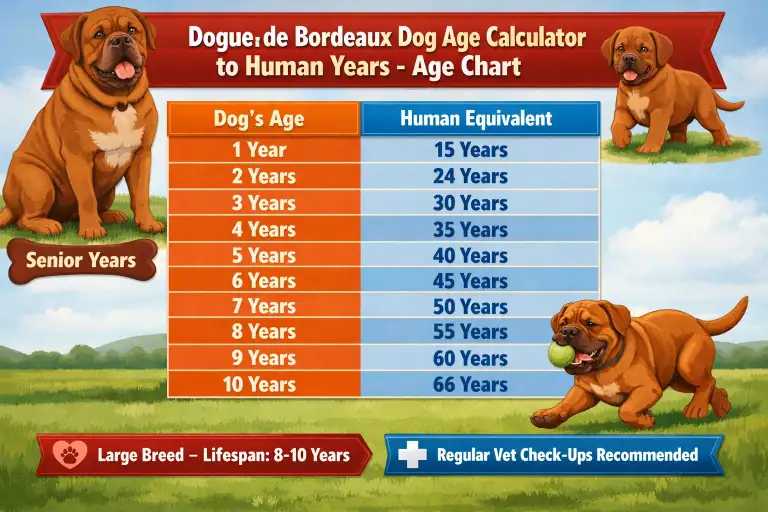
The following Dogue de Bordeaux age chart provides an easy reference for converting your dog’s age into estimated human years. These numbers are based on giant-breed aging patterns and should be used as a general guide rather than an exact measurement.
| Dog Age | Human Age Equivalent | Life Stage |
|---|---|---|
| 1 year | 15–18 years | Puppy |
| 2 years | 24–27 years | Young Adult |
| 3 years | 30–35 years | Adult |
| 4 years | 38–42 years | Adult |
| 5 years | 45–48 years | Adult |
| 6 years | 50–55 years | Senior |
| 7 years | 58–62 years | Senior |
| 8 years | 65–70 years | Senior |
| 9 years | 72–75 years | Geriatric |
| 10 years | 78–82 years | Geriatric |

Ata Ur Rehman is the founder of Pet Age in Human Years Calculator, an educational platform that provides age conversion charts and lifespan guides for dogs, cats, birds, and other companion animals. His work focuses on helping pet owners understand how animal ages translate into human years using commonly accepted age conversion formulas and published lifespan averages.
The website compiles breed and species lifespan data from kennel clubs, breed organizations, and general animal lifespan studies to present simple and easy-to-understand guides for pet owners worldwide.
This website was created to centralize animal age conversion charts into one easy reference platform for pet owners.
This article is for general education. For symptoms, medication, diet changes, or health concerns, use a qualified veterinarian who can assess your individual pet.