On this page
Training a Central Asian Shepherd Dog is very different from training most family pets. Also known as the Alabai, this powerful livestock guardian breed was developed to protect property, livestock, and families while making independent decisions without constant human guidance.
Because of this history, traditional obedience methods that work well for Labrador Retrievers, Golden Retrievers, or German Shepherds often fail with Central Asian Shepherds. Success comes from understanding the breed’s instincts, respecting its independence, and building trust through consistency.
This Central Asian Shepherd training guide explains how to train puppies, adolescents, and adult dogs while avoiding the common mistakes that create behavioral problems in guardian breeds.
Why Central Asian Shepherd Dog Training Is Different
Central Asian Shepherd Dogs were bred to work alone in remote areas, protecting livestock from predators and intruders. Unlike companion breeds that constantly seek human approval, these dogs evaluate situations independently and make decisions for themselves.
Many owners mistakenly label this behavior as stubbornness. In reality, it is a natural trait that made the breed successful for thousands of years as a livestock guardian dog.
Training methods based on endless repetition, constant commands, or physical corrections usually produce frustration rather than results. Instead, these dogs respond best to calm leadership, predictable routines, and clearly defined boundaries.
Another challenge is their slow mental maturity. Although a Central Asian Shepherd may reach its adult size before two years of age, emotional maturity often takes three years or longer.
Socialization goals are also different from those of typical family dogs. Your objective is not to create an overly friendly dog that welcomes every stranger. Instead, successful training produces a dog that remains calm, confident, and neutral in unfamiliar situations.
| Training Factor | Central Asian Shepherd Dog | Typical Companion Breed |
|---|---|---|
| Main purpose | Livestock and property protection | Companionship |
| Thinking style | Independent decision-making | Handler-focused |
| Learning method | Short sessions with clear purpose | Repetition-based training |
| Social behavior | Neutral and selective | Highly social |
| Mental maturity | Slow (2-4 years) | Faster (1-2 years) |
| Risk of poor training | Potentially serious safety concerns | Usually manageable |
How to Train a Central Asian Shepherd Dog Step by Step
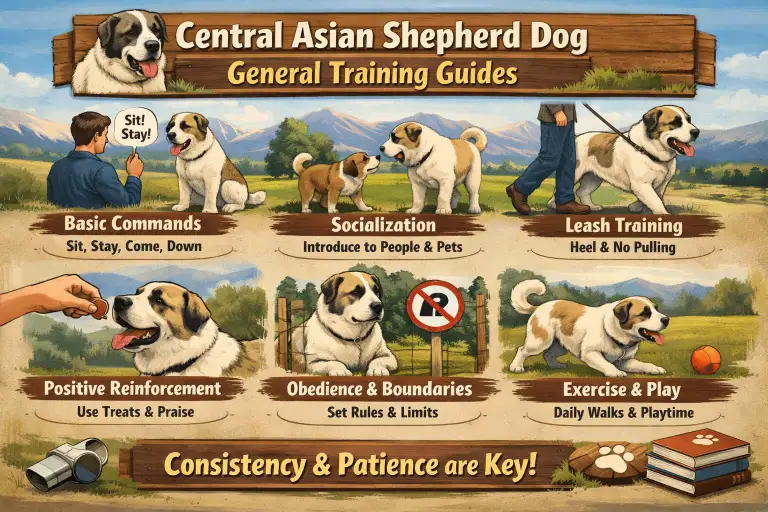
1. Establish Clear Household Rules
Central Asian Shepherds thrive when expectations remain consistent. Teach boundaries from the first day your puppy arrives home.
- Wait calmly at doors.
- Walk politely on a leash.
- Settle quietly when asked.
- Respect furniture and room boundaries.
- Follow feeding routines.
Consistency creates security and reduces unwanted guarding behavior later in life.
2. Focus on Neutral Socialization
One of the biggest mistakes owners make is trying to turn a guardian breed into a social butterfly.
The goal of Central Asian Shepherd socialization is simple:
- Ignore strangers calmly.
- Remain relaxed around other dogs.
- Accept new environments without fear.
- Stay neutral during unexpected situations.
Short, controlled experiences work far better than busy dog parks or crowded public events.
3. Use Rewards That Matter to Your Dog
Not every Central Asian Shepherd is food motivated. Some dogs prefer praise, freedom, space, or the opportunity to stop working.
Reward desired behavior immediately so your dog clearly understands what earned the reward.
4. Keep Training Sessions Short
Guardian breeds lose interest quickly when training becomes repetitive.
| Training Factor | Recommendation |
|---|---|
| Session length | 5-10 minutes |
| Sessions per day | 1-2 sessions |
| Best location | Quiet and familiar environment |
| Reward timing | Immediate |
| Training style | Calm and confident |
Central Asian Shepherd Puppy Training Timeline
| Age | Training Priority | Avoid |
|---|---|---|
| 8-16 weeks | Name recognition, bonding, handling exercises | Harsh corrections |
| 4-10 months | Leash manners, boundaries, neutrality training | Forced social interactions |
| 10-24 months | Impulse control and guardian behavior management | Expecting perfect obedience |
| 2+ years | Reliability and maintenance training | Stopping training completely |
Common Central Asian Shepherd Training Problems and Solutions
Most behavior issues come from misunderstanding guardian breed instincts rather than intentional disobedience.
| Problem | Common Cause | Recommended Solution |
|---|---|---|
| Ignoring commands | Too many repeated commands | Use fewer words and stronger routines |
| Excessive guarding | Poor socialization and unclear leadership | Reward calm and neutral behavior |
| Leash reactivity | Stress or uncertainty | Create distance and reduce pressure |
| Handling resistance | Lack of trust | Use gradual handling exercises with rewards |
| Boundary testing | Inconsistent rules | Maintain predictable expectations |
How to Stop a Central Asian Shepherd From Becoming Overprotective
Overprotective behavior is one of the most common concerns among Central Asian Shepherd owners.
Prevention starts early:
- Teach calm observation rather than reaction.
- Reward neutrality around visitors.
- Avoid encouraging aggressive guarding behavior.
- Maintain clear leadership and structure.
- Do not allow the dog to decide who may enter the home.
Remember that guarding behavior should always remain under human control.
When to Hire a Professional Dog Trainer
Because Central Asian Shepherd Dogs are large, powerful guardians, some situations require professional help immediately.
| Behavior | Risk Level | Recommended Action |
|---|---|---|
| Growling at family members | High | Consult a professional trainer |
| Snapping or biting | Very high | Seek immediate professional assistance |
| Severe fear responses | Moderate to high | Work with a behavior specialist |
| Uncontrolled guarding | High | Find a guardian-breed expert |
| No improvement after months of training | Moderate | Schedule a professional assessment |
Frequently Asked Questions About Central Asian Shepherd Training
Are Central Asian Shepherd Dogs easy to train?
No. Central Asian Shepherd Dogs are intelligent but highly independent. They require patient, consistent, breed-specific training methods rather than traditional obedience approaches.
At what age should Central Asian Shepherd training begin?
Training should begin as soon as your puppy arrives home, usually between 8 and 10 weeks of age. Early socialization and boundary training are critical for guardian breeds.
Can a Central Asian Shepherd live with other dogs?
Many can live successfully with other animals when properly socialized from an early age, although same-sex aggression can occur in some individuals.
How long does it take to train a Central Asian Shepherd Dog?
Training is a lifelong process. Most Central Asian Shepherds do not reach full mental maturity until around three years of age.
Should Central Asian Shepherds go to dog parks?
Most experts do not recommend dog parks for livestock guardian breeds because crowded and unpredictable environments can create stress or conflict.
Final Thoughts
Training a Central Asian Shepherd Dog is not about creating perfect obedience. It is about building trust, establishing boundaries, and teaching a powerful guardian how to live safely in a modern environment.
Owners who respect the breed’s instincts, remain patient, and focus on calm leadership often develop an exceptionally loyal, stable, and reliable protector for their family and property.

Ata Ur Rehman is the founder of Pet Age in Human Years Calculator, an educational platform that provides age conversion charts and lifespan guides for dogs, cats, birds, and other companion animals. His work focuses on helping pet owners understand how animal ages translate into human years using commonly accepted age conversion formulas and published lifespan averages.
The website compiles breed and species lifespan data from kennel clubs, breed organizations, and general animal lifespan studies to present simple and easy-to-understand guides for pet owners worldwide.
This website was created to centralize animal age conversion charts into one easy reference platform for pet owners.
This article is for general education. For symptoms, medication, diet changes, or health concerns, use a qualified veterinarian who can assess your individual pet.