On this page
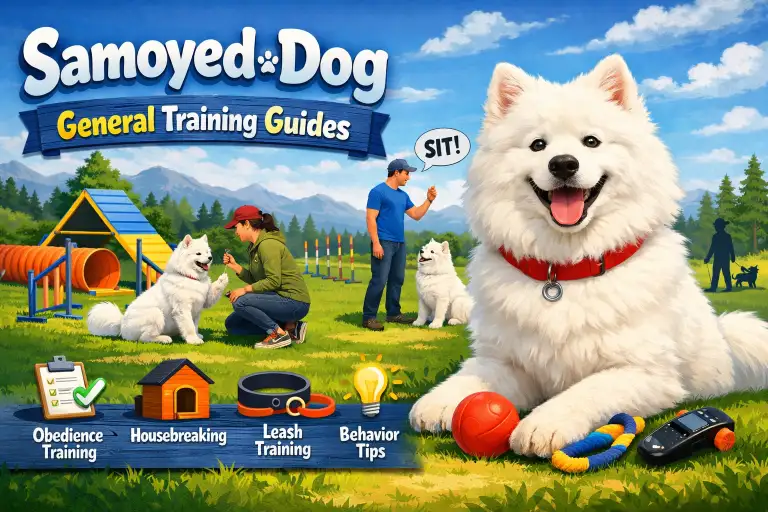
Training a Samoyed requires patience, consistency, and an understanding of the breed’s unique personality. Samoyeds are highly intelligent working dogs, but they are also independent thinkers who respond best to positive reinforcement rather than punishment.
This guide is designed for:
- New Samoyed puppy owners starting obedience training for the first time
- Owners dealing with adolescent Samoyed stubbornness and selective listening
- Families adopting rescue Samoyeds with little or inconsistent training experience
The methods in this guide are based on reward-based dog training, realistic expectations, and an understanding of typical Samoyed behavior and temperament.
Are Samoyeds Easy or Difficult to Train?
Many people ask, “Are Samoyeds easy to train?” The answer is both yes and no.
Samoyeds are extremely intelligent and learn new commands quickly, but they are also independent dogs that often decide whether a command is worth following. This is why many owners mistakenly label them as stubborn.
| Training Factor | Samoyed Characteristics | Owner Expectations |
|---|---|---|
| Intelligence | Excellent problem-solving skills | Learns commands quickly |
| Desire to Please | Moderate | Needs motivation and rewards |
| Independence | High | May ignore commands without value |
| Sensitivity | Emotionally responsive | Harsh corrections reduce confidence |
| Best Training Method | Positive reinforcement | Short and rewarding sessions work best |
Samoyeds are not difficult because they lack intelligence. They are challenging because they think independently and dislike repetitive drills.
Understanding Samoyed Behavior and Learning Style
Successful Samoyed training starts with understanding how the breed was developed. Originally bred to herd reindeer, pull sleds, and work alongside families in Arctic climates, Samoyeds learned to make decisions on their own while remaining closely bonded to humans.
Today, these traits influence how they respond to training.
- They often understand commands but may choose not to respond immediately.
- Repeating commands teaches them to ignore cues.
- Harsh punishment damages trust and motivation.
- Training sessions that feel like games produce the best results.
What many owners call stubbornness is usually a combination of intelligence and independence.
How Samoyed Personality Traits Affect Training
| Samoyed Trait | Typical Behavior | Training Impact |
|---|---|---|
| High Intelligence | Learns quickly | Bored by repetition |
| Independence | Selective listening | Requires strong rewards |
| Social Personality | Loves attention | Praise and play work well |
| Sensitivity | Responds to tone | Gentle guidance is effective |
| Vocal Nature | Barks and talks frequently | Usually communication rather than defiance |
Samoyeds learn best when:
- Rewards are immediate.
- Sessions remain short and engaging.
- Training feels fun and interactive.
- Pressure and punishment are avoided.
Food treats work exceptionally well, but toys, praise, and affection can also become powerful motivators.
Step-by-Step Samoyed Training Plan
The best Samoyed training routine focuses on short, frequent sessions instead of long obedience drills.
- Keep sessions short.
- Train daily.
- Use rewards consistently.
- Practice in low-distraction environments first.
Most Samoyeds perform best with training sessions lasting between 5 and 10 minutes, repeated several times throughout the day.
Samoyed Training Schedule by Age
| Age | Session Length | Sessions Per Day | Primary Goal |
|---|---|---|---|
| 8-16 Weeks | 3-5 Minutes | 3-5 Sessions | Name recognition and focus |
| 4-12 Months | 5-10 Minutes | 2-3 Sessions | Recall and leash training |
| Adult Samoyed | 10 Minutes | 1-2 Sessions | Obedience and manners |
| Rescue Samoyed | 5-10 Minutes | 2 Sessions | Trust and routine building |
Always finish training while your Samoyed is still engaged and successful.
What Commands Should You Teach First?
| Command | Importance | Common Mistake |
|---|---|---|
| Name Recognition | Builds attention | Overusing the name |
| Come | Critical for safety | Calling without rewards |
| Loose Leash Walking | Reduces pulling | Allowing pulling to continue |
| Sit and Down | Foundation skills | Advancing too quickly |
| Calm Greetings | Stops jumping | Rewarding excitement |
Reward your Samoyed immediately after the correct behavior. Timing is one of the most important parts of successful dog training.
Training should progress gradually from indoor environments to yards, quiet parks, and eventually busier locations.
If Your Samoyed Stops Listening
When training suddenly stops working, the cause is usually one of the following:
- The reward is not valuable enough.
- The environment is too distracting.
- The session has gone on too long.
Adjust the training environment instead of assuming the dog is being stubborn.
Common Samoyed Training Problems and Solutions
Most Samoyed behavior problems are normal developmental challenges rather than disobedience.
| Problem | Likely Cause | Best Solution |
|---|---|---|
| Ignoring commands | Too many distractions | Practice in quieter environments |
| Leash pulling | Pulling successfully moves forward | Stop walking when leash tightens |
| Excessive barking | Boredom or lack of stimulation | Increase exercise and enrichment |
| Poor recall | Low-value rewards | Use premium treats and praise |
| Indoor-only obedience | Outdoor excitement | Gradually increase distractions |
| Teenage regression | Adolescence | Remain patient and consistent |
One of the biggest mistakes owners make is repeating commands multiple times. Repetition teaches a Samoyed that listening immediately is optional.
Exercise before training sessions can significantly improve focus and engagement.
How Long Does Samoyed Training Take?
- Minor improvements often appear within 1 to 2 weeks.
- Reliable progress usually appears after 4 to 6 weeks.
- Strong habits often require 2 to 3 months of consistency.
Regression during adolescence is normal and should be expected.
When Should You Hire a Professional Dog Trainer?
Most obedience issues can be handled at home, but some situations require professional support.
Consider professional help if your Samoyed:
- Shows extreme fear or anxiety.
- Displays aggression or biting behavior.
- Becomes increasingly reactive around people or dogs.
- Creates safety concerns at home or outdoors.
- Continues worsening despite consistent training.
Problems That Often Need Professional Support
| Behavior Issue | Home Training Possible? | Professional Help Recommended? |
|---|---|---|
| Basic obedience | Yes | No |
| Leash pulling | Yes | No |
| Excessive barking | Sometimes | Sometimes |
| Fear of people or dogs | No | Yes |
| Aggression or biting | No | Yes |
| Escape behavior | No | Yes |
Professional options include:
- Certified dog trainers for obedience and manners.
- Behavior specialists for fear and aggression cases.
- Veterinary behaviorists when medical issues or anxiety are suspected.
Sudden behavioral changes should always be discussed with a veterinarian because pain and illness can directly affect behavior.
Frequently Asked Questions About Samoyed Training
Are Samoyeds good for first-time dog owners?
Samoyeds can be suitable for dedicated first-time owners who are prepared for regular training, exercise, and grooming requirements.
At what age should you start training a Samoyed puppy?
Basic training and socialization should begin as early as 8 weeks of age.
Do Samoyeds respond well to positive reinforcement?
Yes. Positive reinforcement is considered the most effective and humane training method for Samoyeds.
Why is my Samoyed stubborn?
Most Samoyeds are not stubborn in the traditional sense. Their independence and intelligence often make them selective about following commands.
Can older Samoyeds still be trained?
Absolutely. Adult and rescue Samoyeds can learn new skills successfully with consistency and patience.

Ata Ur Rehman is the founder of Pet Age in Human Years Calculator, an educational platform that provides age conversion charts and lifespan guides for dogs, cats, birds, and other companion animals. His work focuses on helping pet owners understand how animal ages translate into human years using commonly accepted age conversion formulas and published lifespan averages.
The website compiles breed and species lifespan data from kennel clubs, breed organizations, and general animal lifespan studies to present simple and easy-to-understand guides for pet owners worldwide.
This website was created to centralize animal age conversion charts into one easy reference platform for pet owners.
This article is for general education. For symptoms, medication, diet changes, or health concerns, use a qualified veterinarian who can assess your individual pet.