On this page
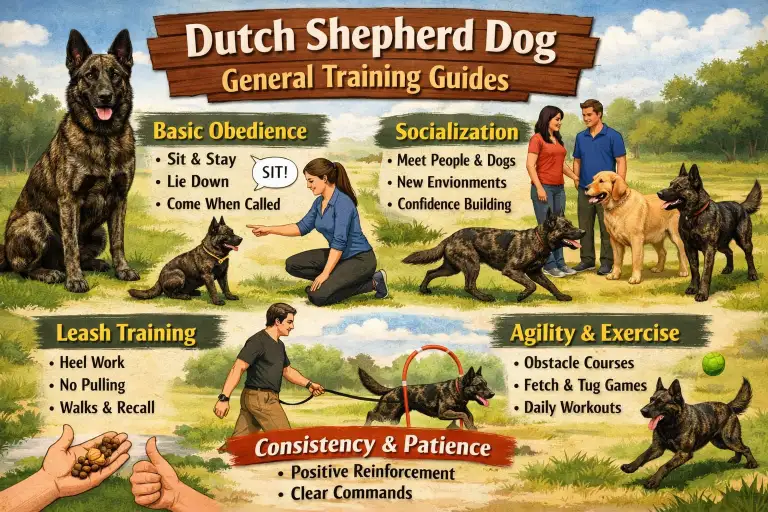
Dutch Shepherd training requires far more than teaching basic commands. This intelligent working breed was developed to herd livestock, guard property, and perform demanding tasks that require focus, endurance, and independent decision-making. Because of their exceptional intelligence and energy, Dutch Shepherds thrive when training provides structure, purpose, and consistent mental engagement.
Many owners underestimate how much guidance this breed needs. A Dutch Shepherd that lacks training often becomes restless, destructive, reactive, or difficult to manage. A properly trained Dutch Shepherd, however, is one of the most loyal, responsive, and dependable canine companions.
This guide explains how Dutch Shepherds learn, which training methods work best, common mistakes to avoid, and how to build reliable obedience from puppyhood through adulthood.
Why Proper Training Is Essential for Dutch Shepherds
Dutch Shepherds are powerful, athletic, and highly alert dogs. Without proper training, these natural strengths can quickly become challenges.
| Well-Trained Dutch Shepherd | Poorly Trained Dutch Shepherd |
|---|---|
| Calm in the home | Constant pacing and restlessness |
| Reliable around distractions | Easily overstimulated |
| Responds to commands | Ignores instructions |
| Safe around guests and dogs | Reactive or aggressive |
| Mentally satisfied | Destructive and frustrated |
| Walks politely on leash | Pulls excessively |
Training is not about controlling a dog through force. It is about teaching communication, boundaries, and emotional regulation.
Understanding Dutch Shepherd Temperament
Before training begins, owners must understand how this breed thinks.
| Breed Trait | Daily Behavior | Training Implication |
|---|---|---|
| High Drive | Constant readiness for activity | Requires daily mental work |
| Highly Intelligent | Learns quickly but gets bored | Needs varied training |
| Sensitive | Responds strongly to tone | Benefits from calm handling |
| Alert | Notices everything | Requires focus training |
| Energetic | Needs regular challenges | Thrives with structured routines |
Dutch Shepherds are not naturally stubborn. Most training problems result from insufficient structure, inadequate exercise, inconsistent rules, or unclear communication.
Dutch Shepherd Training by Age
Training priorities change as your dog matures.
| Age Stage | Primary Training Goals |
|---|---|
| 8–16 Weeks | Socialization and confidence building |
| 4–6 Months | Basic obedience and engagement |
| 6–18 Months | Impulse control and reliability |
| Adult | Advanced obedience and real-world skills |
| Senior | Mental stimulation and maintenance |
Each stage builds upon the previous one. Skipping early training often creates larger problems later.
Dutch Shepherd Puppy Training
The puppy stage is the most important training period.
Focus on:
- Name recognition
- Recall training
- Crate training
- Leash introduction
- Handling exercises
- Socialization
- Bite inhibition
Puppy Socialization Checklist
| Experience | Goal |
|---|---|
| New people | Confidence |
| Friendly dogs | Appropriate social skills |
| Different surfaces | Adaptability |
| Car rides | Reduced anxiety |
| Household noises | Noise tolerance |
| Veterinary handling | Cooperative care |
Socialization should create positive experiences rather than overwhelming the puppy.
Best Dutch Shepherd Training Methods
Modern positive reinforcement methods consistently produce the best results.
Effective Rewards
| Reward Type | Example |
|---|---|
| Food Rewards | Small treats |
| Toy Rewards | Tug or ball play |
| Praise | Verbal encouragement |
| Life Rewards | Access to activities |
Core Training Principles
- Reward desired behavior immediately.
- Keep sessions short and focused.
- Use clear and consistent cues.
- Increase distractions gradually.
- End sessions on success.
Dutch Shepherds respond exceptionally well when training is engaging and rewarding.
Essential Dutch Shepherd Commands
Every Dutch Shepherd should master the following skills.
| Command | Purpose |
|---|---|
| Sit | Foundation behavior |
| Down | Calmness and control |
| Stay | Reliability |
| Come | Safety and recall |
| Leave It | Impulse control |
| Place | Relaxation and boundaries |
| Heel | Loose-leash walking |
| Drop It | Safety and management |
These commands create the foundation for advanced training.
Dutch Shepherd Obedience Training
Obedience training should focus on reliability rather than simply performing commands at home.
Progress through these stages:
| Stage | Environment |
|---|---|
| Beginner | Quiet room |
| Intermediate | Backyard |
| Advanced | Park |
| Real World | Busy public spaces |
The goal is not whether the dog can perform a command. The goal is whether the dog can perform it despite distractions.
Recall Training for Dutch Shepherds
Recall is one of the most important safety skills.
Recall Training Process
- Start indoors.
- Reward every successful response.
- Use a long line outdoors.
- Gradually increase distractions.
- Never punish a dog for returning.
A reliable recall can prevent accidents, escapes, and dangerous encounters.
Leash Training a Dutch Shepherd
Many Dutch Shepherds struggle with pulling due to their athletic nature.
| Common Problem | Recommended Solution |
|---|---|
| Pulling | Stop forward movement |
| Lunging | Increase distance |
| Excessive excitement | Practice engagement exercises |
| Environmental fixation | Reward focus on handler |
Loose-leash walking should be practiced daily in short sessions.
Mental Stimulation for Dutch Shepherds
Mental exercise is just as important as physical exercise.
Recommended Activities
| Activity | Benefit |
|---|---|
| Obedience training | Focus |
| Scent work | Problem-solving |
| Puzzle toys | Mental engagement |
| Trick training | Learning skills |
| Tug games | Controlled drive outlet |
| Search games | Natural instincts |
A mentally satisfied Dutch Shepherd is easier to train and manage.
Common Dutch Shepherd Training Problems
Over-Excitement
Cause:
- Excessive arousal
- Lack of impulse control
Solution:
- Shorter sessions
- More structure
- Relaxation exercises
Reactivity
Cause:
- Poor socialization
- Frustration
- Overstimulation
Solution:
- Distance from triggers
- Focus exercises
- Gradual exposure
Destructive Behavior
Cause:
- Boredom
- Lack of mental stimulation
Solution:
- Daily enrichment
- Structured training
- Interactive activities
Ignoring Commands
Cause:
- Inconsistent expectations
Solution:
- Consistent cues
- Better rewards
- Reduced distractions during learning
Common Training Mistakes
Avoid these mistakes:
| Mistake | Consequence |
|---|---|
| Inconsistent rules | Confusion |
| Long training sessions | Mental fatigue |
| Excessive corrections | Reduced confidence |
| Insufficient exercise | Frustration |
| Poor socialization | Behavioral issues |
| Skipping impulse control | Lack of reliability |
Consistency is more important than intensity.
Advanced Training Activities
Dutch Shepherds excel when given challenging work.
Popular activities include:
- Competitive obedience
- Agility
- Scent detection
- Tracking
- Protection sports
- Search and rescue
- Service work
- Advanced trick training
These activities provide productive outlets for the breed’s natural abilities.
Frequently Asked Questions
Are Dutch Shepherds easy to train?
Yes. Dutch Shepherds are highly intelligent and learn quickly. However, their energy and drive mean they require consistent training and structure.
What is the best age to start Dutch Shepherd training?
Training should begin immediately when the puppy arrives home, typically around 8 weeks of age.
How much training does a Dutch Shepherd need?
Most Dutch Shepherds benefit from 2–4 structured training sessions daily, along with ongoing mental stimulation.
Do Dutch Shepherds respond well to positive reinforcement?
Yes. Positive reinforcement is widely considered the most effective training approach for this breed.
Are Dutch Shepherds good off-leash?
Only after extensive recall training and proofing in different environments.
Why is my Dutch Shepherd destructive?
Destructive behavior is commonly caused by boredom, excess energy, lack of mental stimulation, or insufficient structure.
Final Thoughts
Dutch Shepherd training is not about controlling a high-energy dog. It is about providing clear communication, structure, and meaningful work. This breed thrives when given opportunities to think, learn, and solve problems. Owners who invest time into obedience, socialization, impulse control, and mental enrichment are rewarded with a confident, reliable companion capable of excelling in almost any environment. When training is consistent and purposeful, the Dutch Shepherd becomes one of the most trainable and versatile breeds in the world.

Ata Ur Rehman is the founder of Pet Age in Human Years Calculator, an educational platform that provides age conversion charts and lifespan guides for dogs, cats, birds, and other companion animals. His work focuses on helping pet owners understand how animal ages translate into human years using commonly accepted age conversion formulas and published lifespan averages.
The website compiles breed and species lifespan data from kennel clubs, breed organizations, and general animal lifespan studies to present simple and easy-to-understand guides for pet owners worldwide.
This website was created to centralize animal age conversion charts into one easy reference platform for pet owners.
This article is for general education. For symptoms, medication, diet changes, or health concerns, use a qualified veterinarian who can assess your individual pet.