On this page
Understanding your Alaskan Malamute’s age in human years can help you make better decisions about nutrition, exercise, healthcare, and overall lifestyle. While many people still believe that one dog year equals seven human years, modern research shows that dogs age at different rates throughout their lives. Large breeds such as the Alaskan Malamute mature quickly during their first few years and often enter their senior stage earlier than smaller breeds.
An Alaskan Malamute is a powerful working dog originally bred for strength, endurance, and pulling heavy loads across long distances. Because of their size and genetics, their aging pattern differs significantly from that of toy and small dog breeds. Using an accurate age chart provides a much better understanding of your dog’s life stage than relying on outdated dog-year formulas.
Alaskan Malamute Age Chart
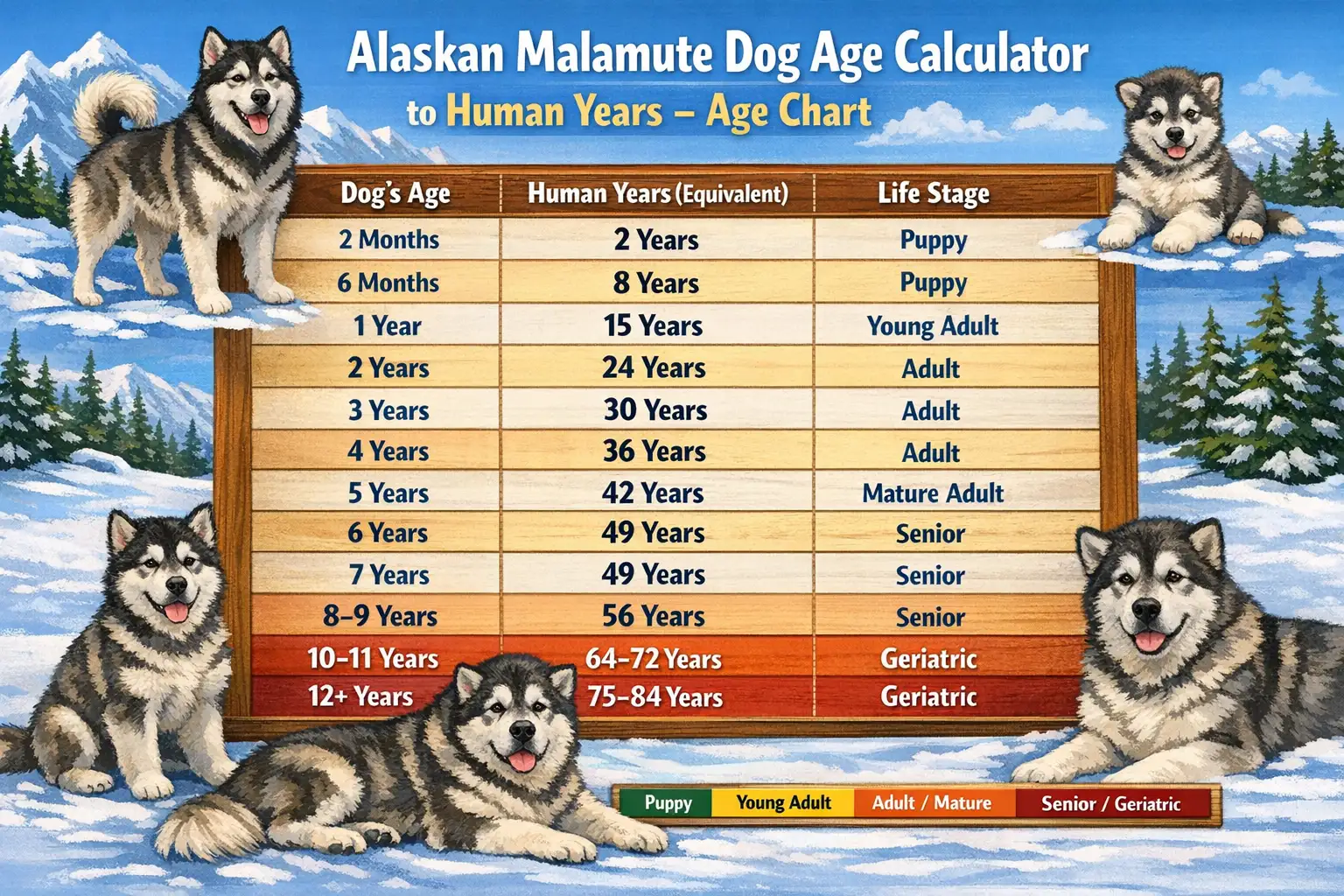
The chart below shows the approximate human age equivalent for an Alaskan Malamute based on commonly accepted large-breed aging models.
| Alaskan Malamute Age | Human Age Equivalent | Life Stage |
|---|---|---|
| 1 Year | 15 Years | Puppy |
| 2 Years | 24 Years | Young Adult |
| 3 Years | 28 Years | Young Adult |
| 4 Years | 34 Years | Adult |
| 5 Years | 36 Years | Adult |
| 6 Years | 42 Years | Adult |
| 7 Years | 47 Years | Senior |
| 8 Years | 52 Years | Senior |
| 9 Years | 57 Years | Senior |
| 10 Years | 62 Years | Senior |
| 11 Years | 66 Years | Senior |
| 12 Years | 71 Years | Senior |
| 13 Years | 76 Years | Senior |
| 14 Years | 81 Years | Senior |
This age chart shows how rapidly Alaskan Malamutes mature during their early years. A one-year-old Malamute has already reached a developmental stage similar to a mid-teenager, while a two-year-old dog is comparable to a young adult human.
Why Alaskan Malamutes Age Differently
Large dog breeds follow a unique aging pattern. They grow quickly during puppyhood, reach physical maturity sooner, and generally have shorter lifespans than smaller breeds.
Several factors influence how an Alaskan Malamute ages:
- Genetics and bloodline quality
- Overall body size and weight
- Diet and nutrition
- Exercise and activity levels
- Preventive veterinary care
- Environmental conditions
- Joint and mobility health
Because Alaskan Malamutes are classified as a large breed, they typically begin showing early signs of aging around seven years of age. This does not mean they are unhealthy, but it does indicate that owners should begin paying closer attention to mobility, weight management, and routine health screenings.
Scientific Explanation of Dog-to-Human Age Conversion
Modern canine aging research has shown that dogs do not age at a constant rate throughout their lives. The first few years involve extremely rapid development, while adulthood progresses more gradually.
For example:
- 1-year-old Malamute ≈ 15-year-old human
- 3-year-old Malamute ≈ 28-year-old human
- 7-year-old Malamute ≈ 47-year-old human
- 12-year-old Malamute ≈ 71-year-old human
This non-linear aging pattern explains why the traditional seven-year rule is inaccurate. Large breeds experience rapid physical development early in life and then continue aging at a different pace throughout adulthood.
Alaskan Malamute Life Stages
Understanding life stages allows owners to adjust care routines as their dog grows older.
Puppy Stage (0–1 Year)
This is the fastest growth period in a Malamute’s life. Puppies require proper nutrition, socialization, vaccinations, and training to build a strong foundation.
Key Characteristics:
- Rapid growth
- Teething
- High energy levels
- Learning and social development
Young Adult Stage (2–3 Years)
By this stage, most Alaskan Malamutes have reached their full size and strength. Their energy levels remain high, and they benefit from consistent exercise and mental stimulation.
Key Characteristics:
- Full physical development
- Strong muscles and endurance
- High activity levels
- Increased confidence
Adult Stage (4–6 Years)
Adult Malamutes are generally at their physical peak. Maintaining healthy body weight and regular exercise becomes increasingly important during this stage.
Key Characteristics:
- Stable temperament
- Peak physical condition
- Strong work capacity
- Consistent energy levels
Senior Stage (7+ Years)
Most Alaskan Malamutes enter their senior years around age seven. Although many remain active well into their later years, owners may begin noticing age-related changes.
Key Characteristics:
- Reduced stamina
- Slower movement
- Joint stiffness
- Increased need for health monitoring
Average Lifespan of an Alaskan Malamute
Alaskan Malamutes typically live between 10 and 14 years. However, lifespan can vary depending on genetics, healthcare, nutrition, and lifestyle.
Compared with other breeds:
| Breed | Size Category | Average Lifespan |
|---|---|---|
| Alaskan Malamute | Large | 10–14 Years |
| Labrador Retriever | Large | 10–12 Years |
| German Shepherd | Large | 9–13 Years |
| Beagle | Medium | 12–15 Years |
| Chihuahua | Small | 14–18 Years |
This comparison highlights how larger breeds generally have shorter lifespans than smaller dogs.
Healthy Aging Tips for Alaskan Malamutes
Although aging cannot be prevented, owners can help their dogs remain healthy and comfortable throughout every life stage.
Maintain a Healthy Weight
Excess weight places additional stress on joints and can accelerate age-related mobility issues.
Provide Regular Exercise
Daily physical activity helps maintain muscle tone, cardiovascular health, and mental well-being.
Support Joint Health
Many aging Malamutes benefit from joint-supportive nutrition and veterinarian-recommended supplements.
Schedule Routine Veterinary Care
Regular wellness examinations can identify health concerns before they become serious.
Encourage Mental Stimulation
Puzzle toys, training sessions, and interactive activities help keep senior dogs mentally engaged.
When Is an Alaskan Malamute Considered a Senior?
Most veterinarians classify Alaskan Malamutes as seniors at approximately seven years of age. At this point, owners should pay closer attention to mobility, weight management, dental care, and preventive health screenings.
Common senior signs include:
- Reduced activity levels
- Joint stiffness
- Longer recovery after exercise
- Changes in appetite
- Changes in sleeping habits
Early recognition of these changes allows owners to make adjustments that improve comfort and quality of life.
To understand your dog's current life stage, use the Alaskan Malamute Dog Age Calculator.
Frequently Asked Questions
How old is an Alaskan Malamute in human years?
An Alaskan Malamute’s age in human years depends on its actual age and the breed’s aging pattern. Large breeds mature rapidly during their first two years and then age more gradually. For example, a 2-year-old Alaskan Malamute is approximately 24 years old in human years, while a 7-year-old Malamute is roughly equivalent to a 47-year-old human.
What is the most accurate Alaskan Malamute age chart?
The most accurate age charts are based on modern canine aging research rather than the outdated “1 dog year equals 7 human years” formula. Large breeds such as Alaskan Malamutes age differently from small breeds, so breed-specific age charts provide a more realistic estimate of human age equivalents.
When is an Alaskan Malamute considered a senior dog?
Most Alaskan Malamutes are considered seniors at around 7 years of age. At this stage, they may begin to show signs of aging such as reduced energy levels, slower movement, joint stiffness, and increased need for veterinary care and health monitoring.
How long do Alaskan Malamutes usually live?
Alaskan Malamutes typically have a lifespan of 10 to 14 years. Factors such as genetics, diet, exercise, weight management, and preventive healthcare can influence how long an individual dog lives.
Is the 7 dog years to 1 human year rule accurate?
No. The traditional 7-to-1 rule is an oversimplified estimate and does not accurately reflect how dogs age. Alaskan Malamutes mature very quickly during their first few years and then age at a different rate throughout adulthood, making breed-specific age charts far more accurate.
Why do Alaskan Malamutes age faster than smaller dogs?
Large breeds generally have shorter lifespans and tend to age faster than small breeds. Their larger body size places additional demands on the body over time, which contributes to earlier aging and a shorter average lifespan compared to smaller dogs.
What life stage is a 5-year-old Alaskan Malamute?
A 5-year-old Alaskan Malamute is considered an adult dog and is roughly equivalent to a 36-year-old human. Most dogs at this age remain active, healthy, and physically strong, provided they receive proper nutrition, exercise, and routine veterinary care.
What life stage is a 10-year-old Alaskan Malamute?
A 10-year-old Alaskan Malamute is considered a senior dog and is approximately equivalent to a 62-year-old human. Dogs at this age often benefit from more frequent health checkups, joint support, weight management, and age-appropriate exercise routines.
Can diet affect how an Alaskan Malamute ages?
Yes. A balanced diet that matches your dog’s age, activity level, and health needs can help maintain a healthy weight, support joint health, and improve overall quality of life. Proper nutrition is one of the most important factors in healthy aging.
How can I help my Alaskan Malamute live a longer life?
Providing a nutritious diet, regular exercise, preventive veterinary care, mental stimulation, and maintaining a healthy weight can all contribute to a longer and healthier life. Early detection of health issues and consistent care throughout every life stage can significantly improve longevity and quality of life.
Final Thoughts
An Alaskan Malamute’s age cannot be accurately measured using the outdated seven-years-per-dog-year formula. Large breeds follow a unique aging pattern that changes throughout their lives. By using an Alaskan Malamute age chart, owners can better understand their dog’s current life stage, anticipate age-related changes, and provide appropriate care from puppyhood through the senior years.
Whether your Malamute is a playful puppy, an active adult, or a wise senior companion, understanding their age in human years provides valuable insight into their health, development, and long-term well-being.

Ata Ur Rehman is the founder of Pet Age in Human Years Calculator, an educational platform that provides age conversion charts and lifespan guides for dogs, cats, birds, and other companion animals. His work focuses on helping pet owners understand how animal ages translate into human years using commonly accepted age conversion formulas and published lifespan averages.
The website compiles breed and species lifespan data from kennel clubs, breed organizations, and general animal lifespan studies to present simple and easy-to-understand guides for pet owners worldwide.
This website was created to centralize animal age conversion charts into one easy reference platform for pet owners.
This article is for general education. For symptoms, medication, diet changes, or health concerns, use a qualified veterinarian who can assess your individual pet.