On this page
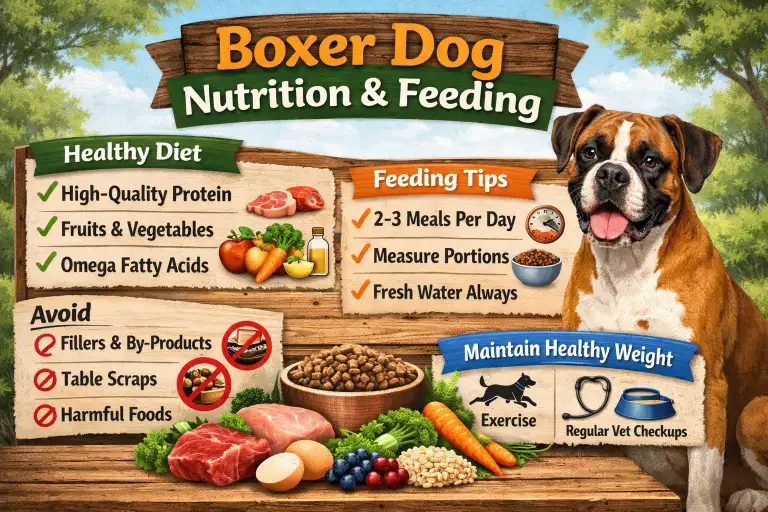
This Boxer feeding guide explains what to feed a Boxer, how much a Boxer should eat, which foods are safe, and how to avoid common feeding mistakes. Boxers are athletic, muscular, high-energy dogs, so their diet needs to support lean muscle, digestion, heart health, joint strength, and stable weight.
A healthy Boxer dog diet should be balanced, easy to digest, and matched to your dog’s age, weight, activity level, and body condition. Boxer puppies, adults, seniors, active dogs, and overweight Boxers all need slightly different feeding routines.
This guide is designed as a complete Boxer nutrition hub. Use it to understand food choices, feeding portions, meal schedules, calorie needs, safe human foods, sensitive stomach issues, and when to adjust your Boxer’s diet.
If you also want to understand your Boxer’s age stage before choosing portions, use our Boxer Dog Age Calculator to compare your Boxer’s age in human years.
What Should a Boxer Eat?
A Boxer should eat a complete and balanced dog food built around quality protein, moderate fat, digestible carbohydrates, fiber, vitamins, and minerals. The goal is not to follow trends. The goal is to support muscle, energy, digestion, heart health, and healthy weight.
Most Boxers do best on a balanced commercial dog food made for their life stage. Homemade, raw, or extreme diets can create nutrient gaps if they are not properly formulated.
Protein: Protein supports muscle maintenance. Because Boxers are naturally muscular dogs, they need reliable animal-based protein from ingredients such as chicken, turkey, beef, lamb, fish, or eggs.
Fat: Fat provides energy and supports skin and coat health. Boxers need enough fat for activity, but too much can cause weight gain or digestive upset.
Carbohydrates and fiber: Digestible carbohydrates give energy, while fiber supports stool quality and gut health. This matters because many Boxers are prone to gas, loose stool, and food sensitivity.
Vitamins and minerals: These support bones, joints, immune health, heart function, and overall body condition. A complete dog food should already include these in safe amounts.
Ideal Boxer Nutrition Ranges
| Nutrient | General Adult Range | Why It Matters for Boxers |
|---|---|---|
| Protein | 22–30% | Supports lean muscle and active movement |
| Fat | 10–18% | Provides energy without excessive weight gain |
| Fiber | 3–6% | Supports digestion and stool quality |
| Omega-3 fats | Regular dietary source | Supports skin, joints, and heart health |
| Calcium and phosphorus | Balanced ratio | Supports bones and joints |
These are general ranges. Boxer puppies, seniors, highly active Boxers, and overweight Boxers may need different calorie levels or food formulas.
How Much Should a Boxer Eat?
How much a Boxer should eat depends on weight, age, activity level, metabolism, and body condition. A Boxer puppy needs more frequent meals for growth, while an adult Boxer usually does best with two measured meals per day.
The chart below gives starting daily calorie ranges. These amounts include meals, treats, toppers, and snacks combined.
Boxer Feeding Chart by Weight and Activity Level
| Boxer Weight | Low Activity | Moderate Activity | High Activity |
|---|---|---|---|
| 50 lb / 23 kg | 1,100–1,300 kcal/day | 1,300–1,500 kcal/day | 1,600–1,800 kcal/day |
| 60 lb / 27 kg | 1,250–1,450 kcal/day | 1,500–1,700 kcal/day | 1,800–2,000 kcal/day |
| 70 lb / 32 kg | 1,400–1,600 kcal/day | 1,700–1,900 kcal/day | 2,000–2,300 kcal/day |
Use this Boxer feeding chart as a starting point, then adjust based on your dog’s waistline, ribs, energy, stool quality, and weight changes.
Boxer Feeding Schedule by Age
| Life Stage | Meals Per Day | Feeding Notes |
|---|---|---|
| Boxer puppy under 6 months | 3–4 meals | Supports growth and steady energy |
| Boxer puppy 6–12 months | 2–3 meals | Reduce gradually as growth slows |
| Adult Boxer | 2 meals | Best for digestion and portion control |
| Senior Boxer | 2 smaller meals | Easier on digestion and weight control |
Avoid feeding one large meal per day. Boxers can be prone to gas and stomach discomfort, so splitting food into two or more meals is usually better.
Boxer Puppy Feeding Chart
Boxer puppies need controlled nutrition for growth. Overfeeding a Boxer puppy can lead to excess weight and unnecessary joint stress, while underfeeding can affect development and energy.
| Puppy Age | Meals Per Day | Feeding Focus |
|---|---|---|
| 8–12 weeks | 4 meals | Small meals, puppy food, steady routine |
| 3–6 months | 3 meals | Growth support and digestive consistency |
| 6–12 months | 2–3 meals | Controlled portions as growth slows |
| 12+ months | 2 meals | Transition toward adult feeding if appropriate |
Large-breed puppy food may be appropriate for many Boxer puppies because it helps support controlled growth. Always transition foods slowly and monitor stool quality.
Best Food Types for Boxer Dogs
There is no single best food for every Boxer. The best Boxer dog food type depends on your dog’s age, health, digestion, budget, and activity level. What matters most is that the food is complete, balanced, digestible, and portioned correctly.
| Food Type | Pros for Boxers | Risks or Limits | Best For |
|---|---|---|---|
| Dry food / kibble | Affordable, easy to measure, usually balanced | Lower moisture | Most healthy Boxers |
| Wet food | More moisture, highly palatable | More expensive, spoils faster | Picky eaters or mixed feeding |
| Fresh food | Often digestible and appealing | Higher cost and storage needs | Owners wanting fresh meals |
| Raw food | High protein approach | Safety and balance risks | Only with expert guidance |
| Homemade food | Full ingredient control | Easy to create nutrient gaps | Only with a properly balanced recipe |
For most Boxer owners, a high-quality kibble, wet food, or fresh food plan is easier and safer than raw or homemade feeding. Raw and homemade diets should not be guessed.
What Can Boxer Dogs Eat?
Boxer dogs can eat some plain, dog-safe human foods in small amounts, but these foods should not replace a balanced dog diet. Treats and extras should stay limited so your Boxer does not gain weight.
| Food | Safe or Unsafe | Notes |
|---|---|---|
| Cooked chicken | Safe | No bones, skin, seasoning, or sauces |
| Cooked eggs | Safe | Good protein source in moderation |
| Plain rice | Safe | Often gentle on the stomach |
| Carrots | Safe | Low-calorie snack |
| Pumpkin | Safe | Can support stool quality |
| Chocolate | Toxic | Never feed |
| Grapes or raisins | Toxic | Never feed |
| Onions or garlic | Toxic | Never feed |
| Fatty leftovers | Unsafe | Can trigger stomach upset |
Safe human foods should be treated as small extras, not meal replacements.
Grain-Free vs Grain-Inclusive Diets for Boxers
Most Boxers do not need a grain-free diet. Rice, oats, barley, and other digestible grains can provide useful energy and may be tolerated well by many Boxer dogs.
A grain-free diet should only be considered when there is a clear reason, such as a confirmed food sensitivity. For most dogs, food quality, digestibility, protein source, calorie control, and overall balance matter more than whether the food contains grains.
Boxer Sensitive Stomach and Gas Issues
Many Boxers have sensitive digestion. Gas, loose stool, vomiting, or frequent stomach upset can happen when food is changed too quickly, meals are too large, ingredients are hard to digest, or the dog eats too fast.
For a Boxer with a sensitive stomach, use a simple feeding routine. Keep meals consistent, avoid too many treats, choose digestible ingredients, and transition foods slowly.
| Problem | Likely Cause | What to Do |
|---|---|---|
| Gas | Eating too fast or food sensitivity | Use a slow-feeder bowl and simplify ingredients |
| Loose stool | Sudden food change | Transition food over 7–10 days |
| Vomiting after meals | Eating too fast or large meals | Split meals and slow eating speed |
| Itchy skin with stomach issues | Possible food sensitivity | Track ingredients and speak with a vet |
How to Switch Boxer Dog Food Safely
Changing Boxer dog food too quickly is one of the most common feeding mistakes. A slow transition helps protect digestion and makes it easier to spot whether the new food is working.
| Day | Old Food | New Food |
|---|---|---|
| 1–2 | 75% | 25% |
| 3–4 | 50% | 50% |
| 5–6 | 25% | 75% |
| 7+ | 0% | 100% |
If your Boxer develops loose stool, vomiting, or poor appetite during the switch, slow down the transition and keep the diet simple.
Boxer Weight Management
Boxers should look muscular, athletic, and lean. Extra weight can place stress on joints, reduce stamina, and make movement harder. Because treats and snacks add up quickly, portion control matters as much as food quality.
| Body Condition | What You See | What to Do |
|---|---|---|
| Too thin | Ribs very visible, low muscle, low energy | Increase calories gradually |
| Healthy | Waist visible, ribs felt but not sharp | Keep current portions |
| Overweight | No clear waist, heavy belly, low stamina | Reduce treats and measure meals |
Use your Boxer’s body condition, not only the feeding label, to decide whether portions are correct.
Senior Boxer Feeding Tips
Senior Boxers often need fewer calories than younger adults, especially if their activity level drops. However, they still need quality protein to support muscle maintenance.
A senior Boxer may benefit from smaller meals, controlled calories, joint-supportive nutrients, digestible protein, and careful weight monitoring. If your senior Boxer is losing weight, refusing food, or gaining weight quickly, the feeding plan should be reviewed.
To understand how your Boxer’s life stage compares with human aging, visit the Boxer Dog Age Chart.
Common Boxer Feeding Mistakes
- Feeding based only on the bag instructions
- Giving too many treats or table scraps
- Switching food too quickly
- Feeding one large meal per day
- Ignoring weight gain after neutering
- Using raw or homemade diets without balance
- Not adjusting food as the Boxer ages
Small feeding mistakes can create long-term problems. The best Boxer feeding routine is measured, consistent, age-appropriate, and adjusted when your dog’s body condition changes.
Related Boxer Guides
Continue building your Boxer care plan with these related guides:
- Boxer Dog Full Guide
- Boxer Dog Age Calculator
- Boxer Dog Training Guide
- Boxer Dog Grooming Guide
- Boxer Dog Cost of Ownership
Boxer Feeding Guide FAQs
How much should a Boxer eat per day?
Most adult Boxers eat about 1,100–2,300 calories per day depending on weight and activity level. A 50 lb Boxer usually needs less than a 70 lb Boxer, and active Boxers need more than low-activity Boxers.
What is the best diet for a Boxer dog?
The best diet for a Boxer dog is complete, balanced, protein-rich, moderate in fat, easy to digest, and matched to age and activity level. Most Boxers do well on quality kibble, wet food, fresh food, or a properly balanced mixed diet.
How often should I feed my Boxer?
Adult Boxers usually do best with two meals per day. Boxer puppies may need three to four meals per day, while senior Boxers often do better with two smaller meals.
Can Boxers eat chicken and rice?
Yes, Boxers can eat plain cooked chicken and rice in small amounts. It should be unseasoned and boneless. Chicken and rice can be useful short term, but it should not replace a complete balanced diet long term.
Do Boxers need grain-free food?
Most Boxers do not need grain-free food. Many Boxers tolerate rice, oats, barley, and other grains well. Grain-free diets should only be used when there is a clear reason.
Why does my Boxer always seem hungry?
A Boxer may seem hungry because of high activity, low-calorie food, too many gaps between meals, habit, or poor portion control. Check body condition before increasing food. If your Boxer is gaining weight, more food is not the answer.
What foods should Boxers avoid?
Boxers should avoid chocolate, grapes, raisins, onions, garlic, alcohol, cooked bones, heavily seasoned foods, and fatty leftovers. These can be toxic or unsafe for dogs.

Ata Ur Rehman is the founder of Pet Age in Human Years Calculator, an educational platform that provides age conversion charts and lifespan guides for dogs, cats, birds, and other companion animals. His work focuses on helping pet owners understand how animal ages translate into human years using commonly accepted age conversion formulas and published lifespan averages.
The website compiles breed and species lifespan data from kennel clubs, breed organizations, and general animal lifespan studies to present simple and easy-to-understand guides for pet owners worldwide.
This website was created to centralize animal age conversion charts into one easy reference platform for pet owners.
This article is for general education. For symptoms, medication, diet changes, or health concerns, use a qualified veterinarian who can assess your individual pet.