On this page
English Mastiffs are famous for their calm nature, unwavering loyalty, and impressive size. While they are often called “gentle giants,” their strength means training is not optional—it is essential. A fully grown English Mastiff can weigh well over 150 pounds, making even small behavior problems difficult to manage if they are not addressed early.
Successful English Mastiff training focuses on consistency, patience, and positive reinforcement rather than punishment. Unlike highly energetic working breeds, Mastiffs learn at their own pace and respond best to calm guidance. Harsh corrections, yelling, or physical punishment can damage trust and reduce their willingness to learn.
Whether you have an English Mastiff puppy or an adult rescue, this guide explains how to develop good manners, teach reliable obedience, prevent common behavioral problems, and build a lifelong bond with your dog.
Why Training an English Mastiff Is So Important
Many owners underestimate how quickly a Mastiff puppy grows. Within a year, a playful puppy can become one of the largest dog breeds in the world. If basic manners are not established early, everyday situations such as walking, greeting visitors, or visiting the veterinarian become much harder.
Training provides far more than obedience. It improves safety, strengthens communication, reduces anxiety, and helps your Mastiff become a confident, well-adjusted family companion.
| Without Proper Training | With Consistent Training |
|---|---|
| Pulls strongly on walks | Walks politely on a loose leash |
| Jumps or leans on people | Greets visitors calmly |
| Ignores commands | Responds reliably to cues |
| Develops unwanted habits | Displays consistent manners |
| Becomes difficult to manage | Remains confident and controllable |
Understanding the English Mastiff Temperament
Before beginning any training program, it is important to understand how this breed naturally behaves.
English Mastiffs are thoughtful rather than impulsive. They often pause before responding to commands, which some owners mistake for stubbornness. In reality, they are processing information carefully.
They are also extremely sensitive to their owner’s tone of voice. Calm praise and rewards usually produce much better results than forceful corrections.
Unlike breeds developed for constant activity, Mastiffs prefer predictable routines. Short daily training sessions fit their personality much better than long repetitive drills.
Key Personality Traits
| Trait | Training Impact |
|---|---|
| Gentle | Responds well to positive reinforcement |
| Protective | Requires early socialization |
| Slow to mature | Needs patience and repetition |
| Intelligent | Learns quickly when motivated |
| Loyal | Builds strong relationships with handlers |
| Powerful | Requires excellent leash manners |
When Should You Start Training?
The ideal time to begin is the day your puppy comes home.
Training does not mean expecting perfect obedience from an eight-week-old puppy. Instead, early lessons should focus on confidence, routine, and good habits.
Puppy Training Timeline
| Age | Primary Goals |
|---|---|
| 8–12 weeks | Name recognition, socialization, potty training |
| 3–4 months | Sit, Down, Come, leash introduction |
| 4–6 months | Stay, Leave It, polite greetings |
| 6–12 months | Loose leash walking, impulse control, distraction training |
| 12+ months | Advanced obedience and reliability |
Adult English Mastiffs can also learn successfully. Although changing long-established habits may require additional patience, positive reinforcement remains highly effective regardless of age.
The Best Training Method for an English Mastiff
Modern research consistently supports reward-based training for giant breeds.
Positive reinforcement teaches your Mastiff which behaviors earn rewards rather than simply punishing mistakes.
Useful rewards include:
- Small soft treats
- Calm verbal praise
- Gentle petting
- Favorite toys
- Brief play sessions
Avoid:
- Alpha or dominance-based techniques
- Physical punishment
- Choke or prong corrections without professional guidance
- Repeated yelling
- Long frustrating training sessions
Daily Training Schedule
Consistency matters more than duration.
| Time | Focus | Duration |
|---|---|---|
| Morning | Leash walking and focus | 10 minutes |
| Afternoon | Basic obedience | 5–10 minutes |
| Evening | Impulse control and settling | 10 minutes |
Several short sessions are far more productive than one long lesson.
Essential Commands Every English Mastiff Should Learn
Sit
Teaching “Sit” creates a foundation for almost every other behavior. Ask your dog to sit before meals, opening doors, greeting guests, or receiving toys.
Down
A reliable “Down” cue helps your Mastiff relax during family activities and public outings.
Stay
Stay develops patience and self-control. Begin with only a few seconds before gradually increasing duration and distance.
Come
Reliable recall can prevent dangerous situations. Always reward your Mastiff generously for returning to you.
Leave It
This command prevents your dog from picking up dangerous food, medications, or objects during walks.
Heel
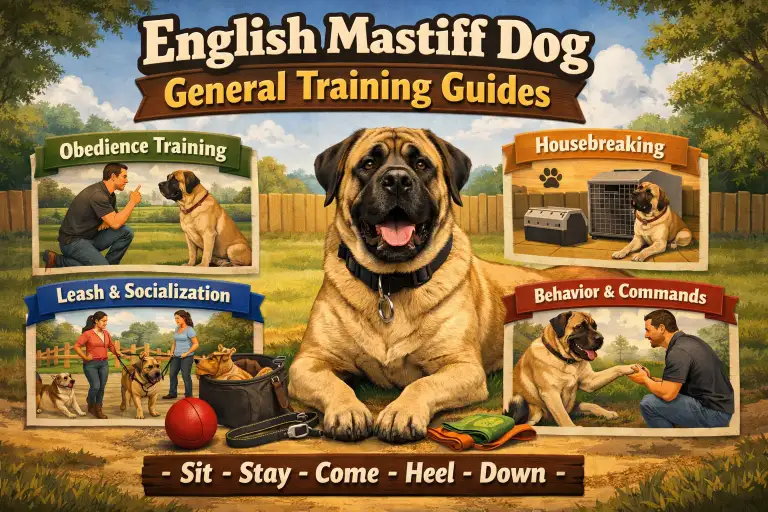
Because of their size, leash manners should become a daily priority. Reward your Mastiff whenever they walk beside you with a loose leash instead of pulling ahead.
Teaching Loose Leash Walking
Leash pulling is one of the most common complaints among English Mastiff owners.
The solution is not strength—it is consistency.
When your Mastiff begins pulling:
- Stop walking immediately.
- Wait until the leash becomes loose.
- Reward the loose leash.
- Continue walking.
- Repeat every time pulling occurs.
Eventually your dog learns that pulling stops forward movement while walking politely keeps the walk going.
Socialization for English Mastiffs
Socialization is one of the most important parts of raising a confident giant breed.
Introduce your Mastiff to:
- Adults
- Children
- Friendly vaccinated dogs
- Different walking surfaces
- Busy streets
- Parks
- Veterinary clinics
- Grooming environments
- Car rides
- Household noises
Every new experience should remain calm, controlled, and positive.
Common English Mastiff Training Problems and Solutions
Even well-socialized English Mastiffs can develop unwanted behaviors if training is inconsistent. Most problems are easier to prevent than correct, so address them early while your dog is still manageable.
| Problem | Common Cause | Solution |
|---|---|---|
| Pulling on the leash | Excitement or lack of leash training | Reward loose leash walking and stop when pulling starts |
| Jumping on visitors | Seeking attention | Ignore jumping and reward calm greetings |
| Ignoring commands | Distractions or inconsistent practice | Train in quiet areas before adding distractions |
| Resource guarding | Fear or insecurity | Trade items for treats and avoid punishment |
| Excessive barking | Boredom or alert behavior | Increase mental stimulation and teach the “Quiet” cue |
| Separation anxiety | Strong attachment to family | Practice short departures and gradual alone time |
| Counter surfing | Food motivation | Keep counters clear and teach “Leave It” |
Exercise and Mental Stimulation
Although English Mastiffs are not high-energy dogs, they still require regular exercise to stay physically and mentally healthy. Too much exercise during puppyhood can place unnecessary stress on developing joints, while too little exercise may contribute to obesity and boredom.
Recommended Daily Exercise
| Age | Daily Exercise |
|---|---|
| 8–16 weeks | 15–20 minutes, several short sessions |
| 4–6 months | 20–30 minutes |
| 6–12 months | 30–45 minutes |
| Adult | 45–60 minutes, depending on health |
Mental enrichment is equally important. Puzzle feeders, scent games, obedience practice, food-dispensing toys, and short training sessions help prevent destructive behaviors.
House Training an English Mastiff
House training should begin immediately after bringing your puppy home.
Successful potty training depends on routine and supervision.
Tips include:
- Take your puppy outside after waking up.
- Go outside after every meal.
- Take frequent potty breaks during play.
- Reward immediately after successful elimination.
- Keep a consistent feeding schedule.
- Supervise indoors until fully trained.
Never punish accidents. Instead, clean the area thoroughly and continue reinforcing the correct behavior.
Crate Training
A crate provides a safe place where your English Mastiff can relax and sleep.
Crate training also supports house training and helps reduce anxiety during travel or veterinary visits.
Choose a crate large enough for your Mastiff to stand, turn around, and lie comfortably.
Never use the crate as punishment.
Nutrition’s Role in Training
High-value treats make training much easier, but giant breeds gain weight quickly.
Choose small, healthy rewards such as:
- Freeze-dried meat treats
- Lean cooked chicken
- Small commercial training treats
- Pieces of kibble from daily meals
Avoid excessive treats that contribute to obesity.
Mistakes to Avoid
Many first-time owners unintentionally create long-term behavior problems.
Avoid these common mistakes:
- Waiting until your puppy is older before starting training.
- Allowing behaviors that will become dangerous when the dog is fully grown.
- Using punishment instead of positive reinforcement.
- Skipping daily practice.
- Allowing everyone in the family to use different commands.
- Expecting immediate results from a slow-maturing breed.
- Over-exercising young puppies.
When to Seek Professional Help
Contact a certified dog trainer or veterinary behaviorist if your English Mastiff displays:
- Aggression toward people or other dogs
- Severe fear or anxiety
- Persistent guarding behavior
- Repeated biting or snapping
- Extreme leash reactivity
- Behavioral changes following illness or injury
Early intervention usually produces better outcomes than waiting until behaviors become deeply established.
Frequently Asked Questions
Are English Mastiffs easy to train?
Yes. English Mastiffs are intelligent and eager to please, but they mature slowly and learn best through patience, consistency, and positive reinforcement rather than harsh corrections.
At what age should I start training my English Mastiff?
Training should begin as soon as your puppy arrives home, usually around eight weeks of age. Early socialization and basic obedience help prevent unwanted behaviors later.
How long should training sessions be?
Most English Mastiffs respond best to sessions lasting between five and ten minutes. Multiple short sessions throughout the day are more effective than one long session.
Do English Mastiffs need professional obedience classes?
Many owners benefit from puppy socialization classes or basic obedience courses, especially if they are raising a giant breed for the first time. Professional guidance can improve confidence for both owner and dog.
Are English Mastiffs aggressive?
A well-bred and properly socialized English Mastiff is generally calm, gentle, and affectionate. Aggression is usually associated with poor socialization, fear, medical issues, or inadequate training rather than the breed itself.
How much exercise does an English Mastiff need?
Healthy adult English Mastiffs usually require 45 to 60 minutes of moderate daily exercise. Puppies need shorter sessions to protect developing joints.
Can an older English Mastiff still be trained?
Absolutely. Adult Mastiffs can learn new commands and improve existing behaviors with consistent practice and positive reinforcement. While progress may take longer than with a puppy, training remains highly effective.
What is the biggest training challenge with English Mastiffs?
Leash manners are often the greatest challenge because of the breed’s enormous size and strength. Teaching loose leash walking early prevents many future problems.
Final Thoughts
Training an English Mastiff is an investment that pays dividends throughout your dog’s life. Their calm personality, intelligence, and devotion make them exceptional companions when guided with patience and consistency. Focus on early socialization, positive reinforcement, clear routines, and daily practice. By teaching reliable obedience from puppyhood and reinforcing good behavior throughout adulthood, you’ll raise a confident, well-mannered giant that is safe, trustworthy, and enjoyable to live with. While English Mastiffs may never be the fastest learners, their steady temperament and deep loyalty make every bit of training worthwhile.

Ata Ur Rehman is the founder of Pet Age in Human Years Calculator, an educational platform that provides age conversion charts and lifespan guides for dogs, cats, birds, and other companion animals. His work focuses on helping pet owners understand how animal ages translate into human years using commonly accepted age conversion formulas and published lifespan averages.
The website compiles breed and species lifespan data from kennel clubs, breed organizations, and general animal lifespan studies to present simple and easy-to-understand guides for pet owners worldwide.
This website was created to centralize animal age conversion charts into one easy reference platform for pet owners.
This article is for general education. For symptoms, medication, diet changes, or health concerns, use a qualified veterinarian who can assess your individual pet.