On this page
Many Staffordshire Bull Terrier owners want to know their Staffy age in human years and how Staffy dog years convert to human years. While the old “1 dog year equals 7 human years” rule is still widely known, modern research shows that dogs age at different speeds throughout their lives. Staffordshire Bull Terriers develop very rapidly during their first two years, experience a long adult stage, and then gradually enter their senior years.
A Staffordshire Bull Terrier is approximately 15 human years old at 1 year of age and about 24 human years old at 2 years. After that, each additional year adds roughly 4–5 human years depending on life stage and overall aging patterns.
Staffy Dog Years to Human Years: Quick Answer
A Staffordshire Bull Terrier reaches approximately:
• 15 human years at age 1
• 24 human years at age 2
• 44 human years at age 7
• 60 human years at age 10
• 69 human years at age 12
This age chart provides a practical estimate based on modern canine aging research and medium-sized dog lifespan patterns.
Why Staffordshire Bull Terriers Do Not Age by the 7-Year Rule
The traditional 7-year formula assumes dogs age at the same rate throughout their lives. In reality, Staffordshire Bull Terriers age much faster during puppyhood and adolescence than during adulthood.
Key reasons the 7-year rule is inaccurate:
• Puppies mature rapidly during the first year
• Young adults experience slower aging during their prime years
• Senior dogs age more quickly as physical changes accumulate
Because of these differences, a 1-year-old Staffordshire Bull Terrier is biologically closer to a teenager than a 7-year-old child. Accurate age conversion requires consideration of growth patterns, breed size, and life stage.
Staffordshire Bull Terrier Life Stages at a Glance
| Staffordshire Bull Terrier Age | Life Stage | What It Means |
|---|---|---|
| 0–12 Months | Puppy | Rapid growth, learning, social development |
| 1–6 Years | Adult | Physical and mental prime |
| 7–10 Years | Mature Adult | Early aging signs may appear |
| 11+ Years | Senior | Increased focus on health and comfort |
Understanding these life stages often provides more useful information than focusing solely on a human age equivalent.
How Long Do Staffordshire Bull Terriers Live? Staffy Lifespan
Staffordshire Bull Terriers generally live between 12 and 14 years. This 12-14 year range is the typical Staffy lifespan, although individual dogs may live longer. Their medium size contributes to a balanced aging pattern compared with both giant and toy breeds.
Several factors influence lifespan:
• Genetics
• Body condition and weight management
• Nutrition
• Exercise levels
• Preventive veterinary care
• Dental health
Many well-cared-for Staffies remain active and energetic throughout much of their lives.
The Science Behind Staffordshire Bull Terrier Aging
Modern canine aging research demonstrates that dogs age in a curved pattern rather than a straight line.
The general pattern looks like this:
• Very rapid aging during puppyhood
• Slower aging through adulthood
• Accelerated aging during senior years
This explains why the first two years account for a large portion of human age equivalency.
Dog Aging Models Compared
| Aging Model | Description | Accuracy |
|---|---|---|
| Traditional 7-Year Rule | Same aging speed every year | Low |
| Size-Based Model | Adjusts for breed size | Moderate |
| Modern Aging Model | Accounts for life stages and biological aging | High |
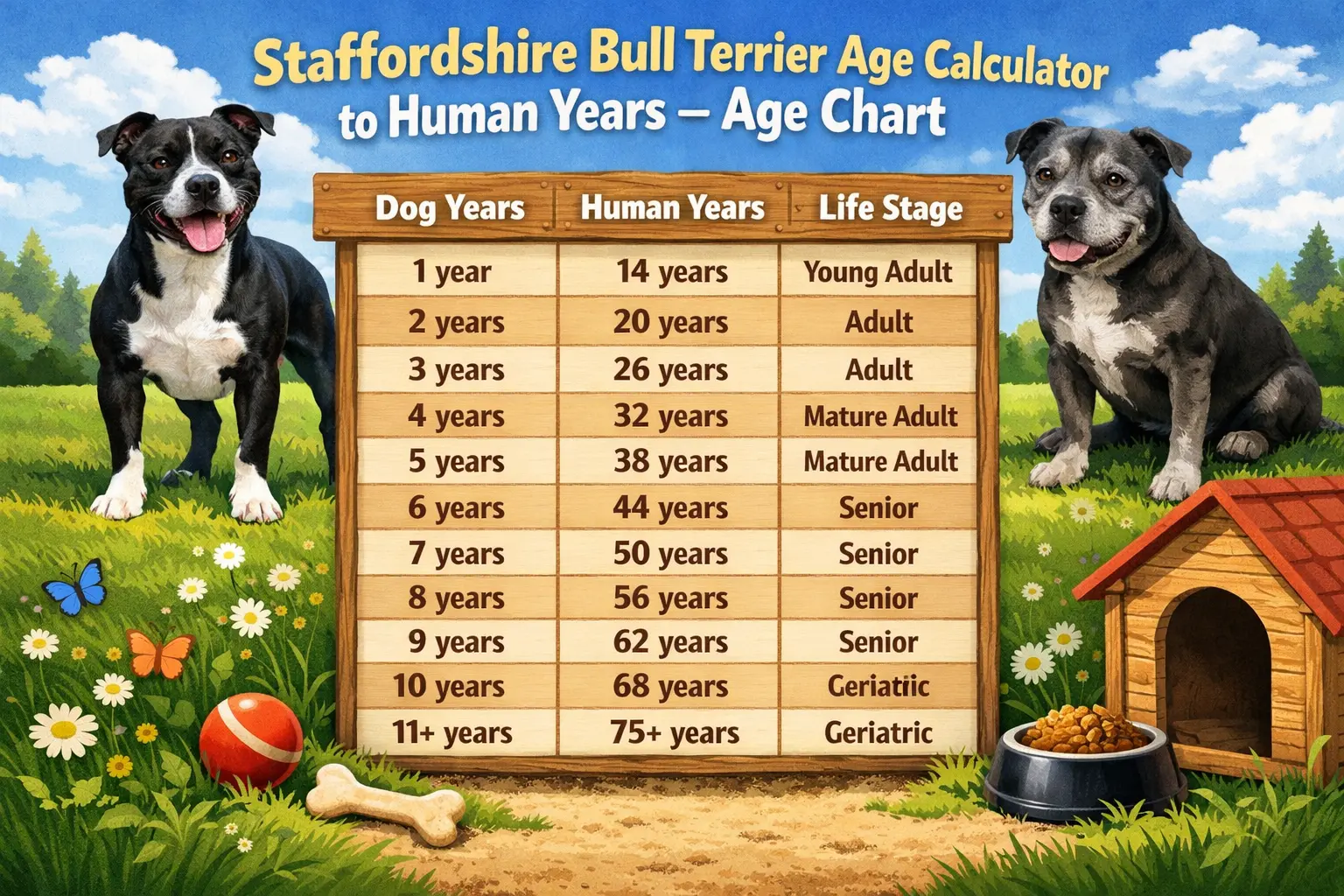
Staffordshire Bull Terrier Age Chart in Human Years
The chart below provides approximate human age equivalents for Staffordshire Bull Terriers.
| Staffordshire Bull Terrier Age | Human Age Equivalent |
|---|---|
| 1 Year | 15 Years |
| 2 Years | 24 Years |
| 3 Years | 28 Years |
| 4 Years | 32 Years |
| 5 Years | 36 Years |
| 6 Years | 40 Years |
| 7 Years | 44 Years |
| 8 Years | 51 Years |
| 9 Years | 56 Years |
| 10 Years | 60 Years |
| 11 Years | 65 Years |
| 12 Years | 69 Years |
| 13 Years | 74 Years |
| 14 Years | 78–80 Years |
| 15 Years | 83-85 Years |
These values are estimates and should be viewed as general aging guidelines rather than exact biological measurements.
Simple Staffordshire Bull Terrier Age Conversion Rule
For a quick estimate:
• First year = approximately 15 human years
• Second year = approximately 9 additional human years
• Each additional year = approximately 4–5 human years
This pattern closely reflects how medium-sized dogs age in real life.
Real-Life Age Examples
| Dog Age | Human Age Equivalent |
|---|---|
| 2 Years | Young adult in early 20s |
| 5 Years | Adult in mid-30s |
| 8 Years | Early senior in early 50s |
| 10 Years | Around 60 years old |
| 12 Years | Late 60s to early 70s |
These comparisons help owners better understand life-stage transitions and changing care requirements.
Staffordshire Bull Terrier Life Stages Explained
Puppy Stage (Birth to 12 Months)
| Puppy Age | Development Stage |
|---|---|
| 8–12 Weeks | Socialization and learning |
| 3–4 Months | Teething period |
| 5–6 Months | Rapid physical growth |
| 7–12 Months | Near-adult size and development |
During this period, puppies require structured training, social exposure, and proper nutrition.
Adult Stage (1–6 Years)
| Adult Age | Typical Characteristics |
|---|---|
| 1–2 Years | High energy and enthusiasm |
| 3–5 Years | Physical and mental peak |
| 6 Years | Early signs of slowing may appear |
Most Staffordshire Bull Terriers spend several years in their healthiest and most active stage.
Mature and Senior Stage (7+ Years)
| Age Range | Common Changes |
|---|---|
| 7–9 Years | Reduced stamina |
| 10–11 Years | Increased joint stiffness |
| 12+ Years | More rest and slower movement |
While many senior Staffies remain playful, they generally benefit from additional health monitoring.
Signs of Old Age in a Staffordshire Bull Terrier
| Area | Possible Signs |
|---|---|
| Mobility | Slower movement and stiffness |
| Energy | Shorter activity periods |
| Weight | Easier weight gain |
| Behavior | More sleeping and relaxation |
Recognizing these changes early can help support healthy aging.
Helping Your Staffordshire Bull Terrier Age Well
Maintaining a healthy weight is one of the most effective ways to support long-term health.
Nutrition by Life Stage
| Life Stage | Feeding Priority |
|---|---|
| Puppy | Growth and development |
| Adult | Balanced nutrition |
| Senior | Weight control and joint support |
Exercise by Life Stage
| Life Stage | Recommended Activity |
|---|---|
| Puppy | Short play sessions |
| Adult | Walks, games, training |
| Senior | Gentle walks and light activity |
Veterinary Care by Age
| Life Stage | Veterinary Focus |
|---|---|
| Puppy | Vaccinations and development |
| Adult | Annual wellness exams |
| Senior | More frequent health screenings |
Regular preventive care often improves quality of life and supports longevity.
How We Calculate Human Age Equivalents
The age estimates in this chart are based on modern canine aging research and medium-breed lifespan models.
Instead of relying on the outdated 7-year rule, these estimates account for:
• Rapid early development
• Slower adult aging
• Accelerated senior aging
Because every dog is unique, actual aging may vary depending on genetics, health, body condition, and lifestyle.
Staffordshire Bull Terrier Age FAQs
How old is a 7-year-old Staffordshire Bull Terrier in human years?
A 7-year-old Staffordshire Bull Terrier is approximately 44 human years old and is generally considered a mature adult entering the early senior stage.
How old is a 10-year-old Staffy in human years?
A 10-year-old Staffordshire Bull Terrier is approximately 60 human years old and is considered a senior dog.
How old is a 12-year-old Staffy in human years?
A 12-year-old Staffordshire Bull Terrier is approximately 69 human years old and is considered a senior dog.
How old is a 14-year-old Staffy in human years?
A 14-year-old Staffordshire Bull Terrier is approximately 78-80 human years old and is considered an advanced senior dog.
How long do Staffordshire Bull Terriers live?
Most Staffordshire Bull Terriers live between 12 and 14 years, although some may exceed this range with excellent care.
When is a Staffordshire Bull Terrier considered a senior?
Most Staffordshire Bull Terriers begin entering their senior years around age 7.
Do Staffordshire Bull Terriers age faster than other dogs?
They generally age more slowly than giant breeds but somewhat faster than very small breeds.
Is the 7-year rule accurate?
No. Dogs age at different rates depending on life stage, breed size, and biological development.
Should older Staffordshire Bull Terriers still exercise?
Yes. Senior Staffies benefit from regular exercise, although activities should be adjusted to their fitness level and mobility.
What is the oldest recorded age for a Staffordshire Bull Terrier?
While most Staffies live between 12 and 14 years, some individuals have lived significantly longer with exceptional genetics and care.
Final Thoughts
A Staffordshire Bull Terrier’s age cannot be accurately measured using the old 7-year rule. Like most dogs, Staffies age rapidly during their first two years, enjoy a long adult phase, and then gradually transition into their senior years.
Using a Staffordshire Bull Terrier age chart provides a more realistic understanding of your dog’s life stage and overall aging process. Whether your Staffy is a playful puppy, an energetic adult, or a wise senior companion, understanding their age in human years can help you provide the right care at every stage of life.

Ata Ur Rehman is the founder of Pet Age in Human Years Calculator, an educational platform that provides age conversion charts and lifespan guides for dogs, cats, birds, and other companion animals. His work focuses on helping pet owners understand how animal ages translate into human years using commonly accepted age conversion formulas and published lifespan averages.
The website compiles breed and species lifespan data from kennel clubs, breed organizations, and general animal lifespan studies to present simple and easy-to-understand guides for pet owners worldwide.
This website was created to centralize animal age conversion charts into one easy reference platform for pet owners.
This article is for general education. For symptoms, medication, diet changes, or health concerns, use a qualified veterinarian who can assess your individual pet.