On this page
Border Collies age faster than humans, especially during puppyhood and early adulthood. A Border Collie does not age at a simple rate of seven human years for every dog year. Their first year represents rapid physical and mental development, while later years progress more gradually.
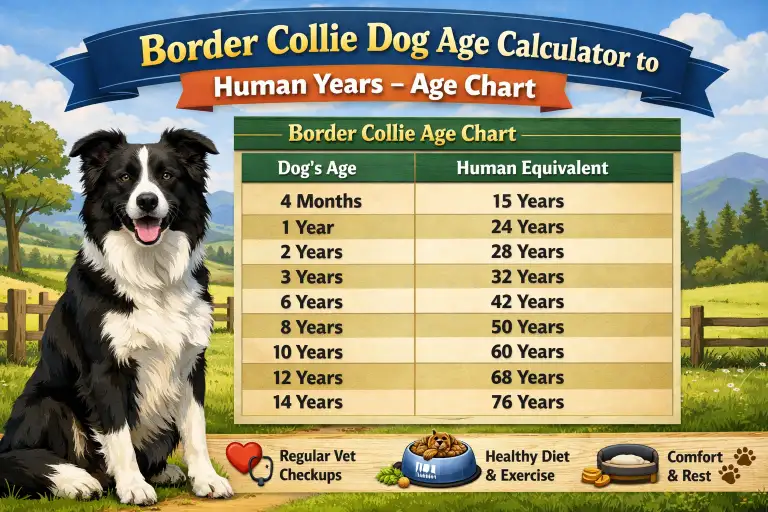
This Border Collie age chart helps you compare dog years to human years by life stage. It is designed for owners who want a clear age reference before checking a more exact result with the Border Collie dog age calculator.
Border Collies are medium-sized dogs, so they usually age at a moderate pace compared with toy breeds and giant breeds. Their aging pattern is affected by size, genetics, activity level, weight, diet, and overall health. That is why a year-by-year chart is more useful than the old “one dog year equals seven human years” rule.
Why the “7 Dog Years” Rule Doesn’t Work
| Factor | How It Affects Aging | What It Means for Border Collies |
|---|---|---|
| Rapid puppy growth | Dogs mature very quickly in the first year | A 1-year-old Border Collie is already similar to a young adult human |
| Breed size | Dog size affects aging speed and life expectancy | Border Collies age more steadily than many giant breeds |
| Life stages | Aging is not linear from puppy to senior | Care needs change at each stage |
| Health and lifestyle | Weight, exercise, diet, and veterinary care influence aging | Healthy habits can support better quality of life |
Border Collie Age Chart: Dog Years to Human Years
The chart below gives an estimated Border Collie age in human years. These numbers are approximate because every dog ages differently, but they give a useful guide for understanding maturity, adult maintenance, and senior care needs.
| Border Collie Age | Estimated Human Age | Life Stage |
|---|---|---|
| 1 year | 15 human years | Young adult |
| 2 years | 24 human years | Adult |
| 3 years | 28 human years | Adult |
| 4 years | 32 human years | Adult |
| 5 years | 36 human years | Adult |
| 6 years | 40 human years | Mature adult |
| 7 years | 44 human years | Mature adult |
| 8 years | 48 human years | Senior transition |
| 9 years | 52 human years | Senior |
| 10 years | 56 human years | Senior |
| 11 years | 60 human years | Senior |
| 12 years | 64 human years | Senior |
| 13 years | 68 human years | Senior |
| 14 years | 72 human years | Senior |
| 15 years | 76 human years | Advanced senior |
| 16 years | 80 human years | Advanced senior |
For a faster estimate based on your dog’s exact age, use the Border Collie age calculator.
How Border Collie Years Convert to Human Years
Border Collie years convert to human years unevenly. The first year includes major puppy development, growth, social learning, and early maturity. By the second year, most Border Collies are physically mature, although many still have high energy and strong working-drive behavior.
After the first two years, each additional dog year is commonly estimated as about four human years for a medium-sized dog. This is why a 10-year-old Border Collie is not simply 70 in human years. A better estimate is closer to the mid-to-late 50s, depending on health, size, and lifestyle.
What the Border Collie Age Chart Helps You Understand
| Dog’s Life Stage | What the Chart Helps With |
|---|---|
| Puppy | Understanding fast growth, training windows, and early development |
| Young adult | Balancing high energy, structure, exercise, and nutrition |
| Adult | Maintaining weight, dental health, fitness, and routine care |
| Senior | Adjusting activity, comfort, mobility support, and health monitoring |
Border Collie Life Stages by Age
Border Collies pass through clear life stages. These stages matter because a puppy, adult, and senior Border Collie need different levels of training, exercise, nutrition, recovery time, and veterinary attention.
| Dog Age | Life Stage | Care Focus |
|---|---|---|
| 0–12 months | Puppy | Growth, socialization, basic training, safe exercise |
| 1–2 years | Young adult | Structure, impulse control, exercise balance, skill building |
| 3–6 years | Adult | Fitness, dental care, weight control, enrichment |
| 7–8 years | Mature adult / senior transition | Monitoring stiffness, recovery time, and activity tolerance |
| 9+ years | Senior | Comfort, mobility, regular checkups, lower-impact activity |
Life Stage Care Priorities
| Life Stage | Primary Focus | Owner Goal |
|---|---|---|
| Puppy | Growth and learning | Build healthy habits early |
| Young adult | Training consistency and controlled activity | Channel energy safely |
| Adult | Maintenance and performance | Sustain fitness and condition |
| Senior | Comfort and prevention | Protect quality of life |
Physical and Behavioral Changes by Border Collie Age
As Border Collies age, their physical ability and behavior gradually change. Puppies are curious, impulsive, and energetic. Adult Border Collies usually become more focused, reliable, and physically capable. Senior Border Collies may slow down, need more recovery time, and prefer calmer routines.
These changes are normal, but they should still be watched carefully. Sudden stiffness, weight gain, appetite changes, confusion, or reduced interest in activity may signal that your Border Collie needs a veterinary checkup.
Typical Changes by Age Range
| Age Range | Common Changes | Helpful Adjustments |
|---|---|---|
| 0–6 months | Fast growth, short focus, high curiosity | Short training sessions and frequent rest |
| 6–12 months | More drive, more stamina, testing limits | Consistent structure and safe activity |
| 1–3 years | High energy, athletic ability, strong work drive | Balanced exercise, training, and mental enrichment |
| 4–6 years | Stable behavior and mature condition | Weight control, dental care, and routine checkups |
| 7–8 years | Possible slower recovery after intense activity | Watch joints, adjust exercise intensity, monitor weight |
| 9+ years | Senior changes such as stiffness or lower stamina | Low-impact activity, comfort support, and regular health monitoring |
When Is a Border Collie Considered Senior?
A Border Collie is usually considered senior around 8 to 9 years old, although some dogs show senior changes earlier or later. Energy level, weight, joint health, dental condition, and overall fitness all affect how quickly a Border Collie appears to age.
Senior age does not mean a Border Collie should stop being active. It means exercise should become more controlled, recovery time should be respected, and health changes should be noticed earlier.
Senior Border Collie Care Checklist
| Care Area | What to Focus On |
|---|---|
| Exercise | Use shorter, frequent, lower-impact sessions |
| Joint health | Watch stiffness, slipping, limping, or reluctance to jump |
| Mental stimulation | Continue puzzle toys, scent games, and simple training |
| Weight management | Adjust calories if activity level decreases |
| Veterinary care | Schedule regular senior wellness checks |
| Comfort | Use supportive bedding and avoid overexertion |
Low-Impact Activities for Senior Border Collies
| Activity | Benefit |
|---|---|
| Sniff walks | Mental engagement with less physical strain |
| Puzzle toys | Cognitive stimulation and enrichment |
| Light training refreshers | Maintains confidence and focus |
| Gentle walks | Supports mobility without overloading joints |
| Calm interactive play | Encourages bonding without overexertion |
Border Collie Age Chart FAQs
How old is a Border Collie in human years?
A 1-year-old Border Collie is roughly 15 in human years, while a 2-year-old Border Collie is about 24 in human years. After that, each additional dog year is usually estimated as about four human years for a medium-sized dog.
How old is a 5-year-old Border Collie in human years?
A 5-year-old Border Collie is approximately 36 in human years. At this age, most Border Collies are mature adults with strong energy, stable behavior, and ongoing needs for exercise and mental stimulation.
How old is a 7-year-old Border Collie in human years?
A 7-year-old Border Collie is approximately 44 in human years. This is usually a mature adult stage, although some Border Collies may begin showing early signs of slower recovery or stiffness.
How old is a 10-year-old Border Collie in human years?
A 10-year-old Border Collie is approximately 56 in human years. At this stage, many Border Collies are considered seniors and may benefit from lower-impact exercise, weight monitoring, and regular wellness checks.
How old is a 12-year-old Border Collie in human years?
A 12-year-old Border Collie is approximately 64 in human years. This is a senior life stage where comfort, joint support, dental care, and careful activity management become more important.
How old is a 15-year-old Border Collie in human years?
A 15-year-old Border Collie is approximately 76 in human years. This is an advanced senior age, so daily comfort, gentle movement, and close health monitoring should be priorities.
When is a Border Collie considered senior?
A Border Collie is usually considered senior around 8 to 9 years old. Some dogs may show senior changes earlier or later depending on weight, activity level, genetics, and overall health.
Is the seven-year dog age rule accurate for Border Collies?
No. The seven-year rule is too simple because Border Collies age faster in the first two years and then more gradually as adults. A breed-specific age chart gives a better estimate.
Border Collie Age in Human Years: Quick Answers
Here are quick estimates for common Border Collie age searches. These answers are based on the age chart above and are useful when you want a fast human-years comparison.
| Search Question | Quick Answer |
|---|---|
| How old is a 4-year-old Border Collie in human years? | A 4-year-old Border Collie is approximately 32 in human years. |
| How old is a 6-year-old Border Collie in human years? | A 6-year-old Border Collie is approximately 40 in human years. |
| How old is an 8-year-old Border Collie in human years? | An 8-year-old Border Collie is approximately 48 in human years. |
| How old is a 9-year-old Border Collie in human years? | A 9-year-old Border Collie is approximately 52 in human years. |
| How old is an 11-year-old Border Collie in human years? | An 11-year-old Border Collie is approximately 60 in human years. |
| How old is a 13-year-old Border Collie in human years? | A 13-year-old Border Collie is approximately 68 in human years. |
| How old is a 14-year-old Border Collie in human years? | A 14-year-old Border Collie is approximately 72 in human years. |
| How old is a 16-year-old Border Collie in human years? | A 16-year-old Border Collie is approximately 80 in human years. |

Ata Ur Rehman is the founder of Pet Age in Human Years Calculator, an educational platform that provides age conversion charts and lifespan guides for dogs, cats, birds, and other companion animals. His work focuses on helping pet owners understand how animal ages translate into human years using commonly accepted age conversion formulas and published lifespan averages.
The website compiles breed and species lifespan data from kennel clubs, breed organizations, and general animal lifespan studies to present simple and easy-to-understand guides for pet owners worldwide.
This website was created to centralize animal age conversion charts into one easy reference platform for pet owners.
This article is for general education. For symptoms, medication, diet changes, or health concerns, use a qualified veterinarian who can assess your individual pet.