On this page
An Australian Shepherd Bernese Mountain Dog mix combines two intelligent working breeds with different builds, energy levels, and historical jobs. The result may be a medium-large or large dog that is deeply attached to family, highly trainable, heavily coated, and more active than the average Bernese Mountain Dog.
This cross is also called an Aussie Bernese, Bernese Aussie, or Australian Mountain Dog. Because it is not a standardized breed, adult size, coat, eye color, temperament, and lifespan can vary significantly—even among littermates.
Key Takeaways
- The mix combines the Australian Shepherd’s herding heritage with the Bernese Mountain Dog’s Swiss farm and draft-dog background.
- Adult size can vary widely because Australian Shepherds are typically much smaller than Bernese Mountain Dogs.
- Both parents have double coats, so regular shedding and brushing should be expected.
- Many individuals need substantial mental stimulation and daily exercise, especially when they inherit strong Australian Shepherd work drive.
- Herding behaviors such as chasing, circling, or trying to control movement may appear.
- Health screening should cover recommended tests for both parent breeds.
- Temperament cannot be predicted by saying the puppy is “half Aussie, half Berner.” Genetics, socialization, training, and the individual dog all matter.
What is an Australian Shepherd Bernese Mountain Dog mix?
It is a cross between an Australian Shepherd and a Bernese Mountain Dog.
The Australian Shepherd is a medium-sized herding breed known for intelligence, stamina, athleticism, and a strong desire to work. The Bernese Mountain Dog is a much larger working breed historically used on Swiss farms for jobs that included driving cattle and pulling carts.
The mix therefore brings together:
- a lighter, faster herding dog
- a heavier, calmer farm and draft dog
- two people-oriented breeds
- two double-coated breeds
- two dogs that tend to benefit from training and purposeful activity
There is no official breed standard for the cross. Names such as “Australian Mountain Dog” are informal labels rather than guarantees about genetics or traits.
Australian Shepherd vs. Bernese Mountain Dog
Understanding the parent breeds gives the most realistic range of possibilities.
| Trait | Australian Shepherd | Bernese Mountain Dog |
|---|---|---|
| Typical adult weight | 40–65 lb | 70–115 lb |
| Typical height | 18–23 in | 23–27.5 in |
| Life expectancy reference | 12–15 years | 7–10 years |
| Historical role | Herding/ranch work | Farm and draft work |
| Coat | Medium double coat | Thick moderately long double coat |
| Activity | Usually high | Usually moderate |
| Training needs | Very intelligent, needs engagement | Intelligent, eager to please, sensitive |
A mixed dog can fall anywhere within or occasionally outside familiar parent ranges.
How big does an Australian Shepherd Bernese Mountain Dog mix get?
A realistic expectation is a medium-large to large adult, but no exact number is guaranteed.
Because Australian Shepherds may weigh roughly 40–65 pounds while Bernese Mountain Dogs may weigh 70–115 pounds, littermates can finish at noticeably different sizes.
Adult size is influenced by:
- sex
- actual size of both parents
- grandparents and family lines
- body structure inherited from each side
- nutrition during growth
- health
Do not rely on a simple formula that averages the parents. If size matters for housing, travel, or physical handling, ask for the verified adult size of both parents and previous offspring from the same lines.
When will an Aussie Bernese be full grown?
Large mixed-breed puppies often gain height before they finish filling out through the chest and body. Some may look lanky during adolescence and continue developing mature muscle and frame after most height growth has occurred.
Avoid trying to accelerate growth through excess feeding. Growing too heavy too quickly can add unnecessary stress to developing joints.
A veterinarian can help you monitor body condition and recommend an appropriate large-breed growth diet when needed.
What does an Aussie Bernese look like?
Appearance is highly variable.
Possible traits include:
- medium to long double coat
- sturdy or athletic body
- black, white, tan, copper, red, gray, or merle patterning
- Bernese-like tricolor markings
- Australian Shepherd-style merle
- floppy or semi-folded ears
- brown, blue, amber, or mismatched eye colors
- feathering on the tail and legs
- a lighter Aussie-like frame or a heavier Berner-like build
A breeder cannot honestly promise that every puppy will have one exact color, eye pattern, or adult appearance.
A note about merle coloring
Merle comes from the Australian Shepherd side of this cross. It creates mottled patches of lighter and darker pigment and can also be associated with blue or partially blue eyes.
Breeding decisions involving merle require genetic knowledge. Puppies that inherit two copies of merle can have a much higher risk of serious hearing and vision abnormalities.
A responsible breeder should understand the genetics involved and should not make “rare color” the primary reason for producing a litter.
Australian Shepherd Bernese Mountain Dog temperament
Many of these dogs are likely to be intelligent, social with family, and responsive to training. The challenge is that the energy and intensity can vary widely.
Possible traits include:
- strong attachment to family
- eagerness to learn
- alertness to movement and environmental changes
- playful energy
- sensitivity to harsh correction
- some reserve with strangers
- herding or chasing behavior
- frustration when bored
- a desire for a daily job or routine
An Aussie-looking puppy may mature calmer than expected, while a Berner-looking puppy may inherit substantial herding drive. Appearance does not reliably predict behavior.
Are Aussie Bernese mixes good family dogs?
They can be excellent family companions when the household is prepared for a smart, substantial dog.
A good fit usually includes:
- adults willing to train consistently
- daily exercise
- mental enrichment
- early socialization
- supervised dog-child interaction
- time for grooming
- a plan for adolescence
Australian Shepherd influence can produce chasing, circling, barking, or heel-nipping toward moving children. Those behaviors are not “bad personality”; they can reflect herding instinct and arousal. Teach alternative behaviors early rather than allowing repeated rehearsal.
Large adolescents can also knock over young children accidentally.
Are they good with other dogs and cats?
Many can live successfully with other pets, but social compatibility is individual.
For puppies:
- introduce cats calmly and prevent chasing
- reward disengagement and relaxed behavior
- use gates and safe escape spaces
- supervise interactions
- teach recall and leave-it cues
With other dogs, focus on appropriate social skills rather than assuming every dog needs constant group play. Some adults become more selective as they mature.
Exercise needs
Most Aussie Bernese mixes should not be treated as low-energy dogs.
A healthy adult may enjoy:
- brisk walks
- hiking
- structured fetch
- scent games
- obedience training
- rally
- trick training
- food puzzles
- controlled off-leash activity in secure areas
Mental work matters as much as mileage. A dog with strong Australian Shepherd influence may remain restless after a long walk if it has had no opportunity to think, learn, or solve problems.
Puppies need age-appropriate activity rather than repetitive high-impact exercise while joints develop.
Training an Aussie Bernese puppy
Start before the puppy becomes physically powerful.
Prioritize:
- name response
- recall
- loose-leash walking
- calm greetings
- leave it
- drop it
- settle on a mat
- handling for grooming and veterinary care
- comfortable time alone
- calm behavior around moving children, bicycles, and other triggers
Reward-based training tends to suit both parent influences. Harsh physical corrections can increase fear, avoidance, or conflict and are especially unhelpful with sensitive dogs.
If persistent reactivity, guarding, fear, or separation distress appears, seek professional help early.
Grooming and shedding
Expect substantial shedding.
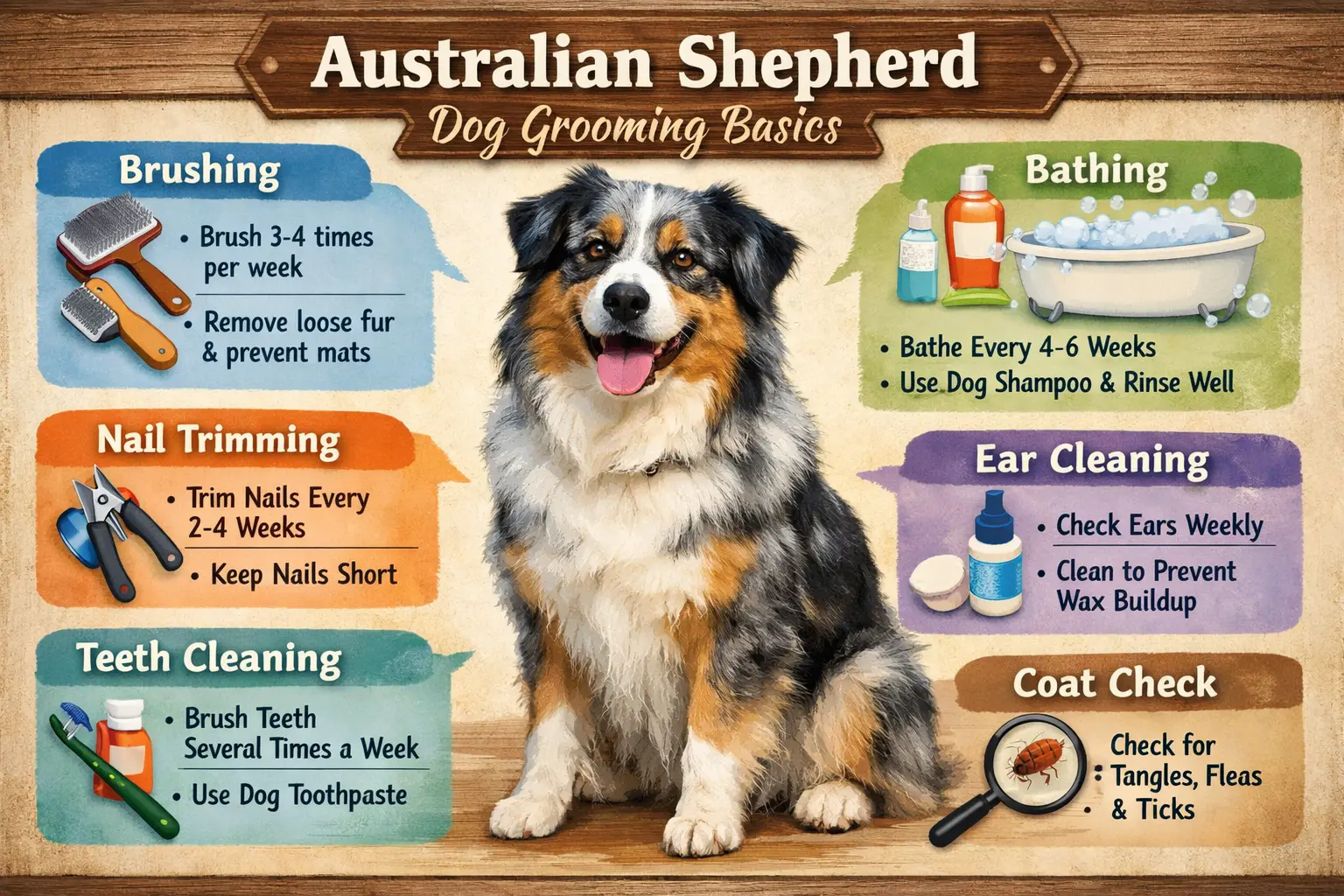
Both parent breeds have double coats. Most mixes benefit from brushing several times a week, with more frequent care during heavy seasonal shedding.
Check areas prone to tangling:
- behind the ears
- armpits
- chest
- backs of the legs
- tail
- under collars and harnesses
Also maintain:
- nails
- ears
- dental care
- bathing as needed
- skin checks beneath the thick coat
Routine shaving is not a reliable solution to shedding and can alter how a double coat grows back.
How does the mix handle hot weather?
A dense coat plus a medium-large or large body can make hot weather challenging.
Use sensible heat management:
- walk during cooler parts of the day
- provide shade and fresh water
- keep indoor cooling available
- avoid strenuous midday exercise
- check pavement temperature
- never leave the dog in a hot vehicle
Heavy panting, weakness, vomiting, confusion, or collapse in heat requires urgent veterinary attention.
Health considerations
Mixed-breed dogs can inherit risk from either parent.
Australian Shepherd breeding programs commonly focus on orthopedic health, eye disease, hereditary cataracts, and relevant DNA variants such as MDR1 drug sensitivity.
Bernese Mountain Dog health programs emphasize orthopedic disease, eye and cardiac screening, breed-relevant genetic conditions, and a significant family-history concern with cancer.
For a planned cross, ask for documentation rather than accepting “both parents are healthy.”
Useful questions include:
- Have both parents had hip and elbow evaluations?
- Have current eye examinations been completed where recommended?
- Has the Australian Shepherd parent had relevant DNA testing?
- What cardiac screening was done?
- What is the cancer and longevity history in the Bernese family?
- Can results be independently verified?
- What happens if the puppy develops a hereditary condition?
Does crossbreeding make this dog healthier?
Not automatically.
Genetic diversity can reduce the chance of some recessive disorders when parents carry different variants, but it does not erase:
- hip dysplasia
- elbow dysplasia
- eye disease
- cardiac disease
- cancer risk
- drug-sensitivity variants
- other inherited problems
“Hybrid vigor” is not a substitute for careful parent selection and testing.
Lifespan
There is no reliable population-wide lifespan figure for the Australian Shepherd Bernese Mountain Dog mix.
Parent-breed references are roughly:
- Australian Shepherd: 12–15 years
- Bernese Mountain Dog: 7–10 years
A mixed dog may fall within, below, or above those ranges. Adult size, inherited disease, cancer risk, body condition, accidents, and preventive care all influence longevity.
If you want broader life-stage context as your dog matures, a pet-to-human age calculator can help frame age, but it cannot predict lifespan or health for an individual mixed-breed dog.
Feeding and body condition
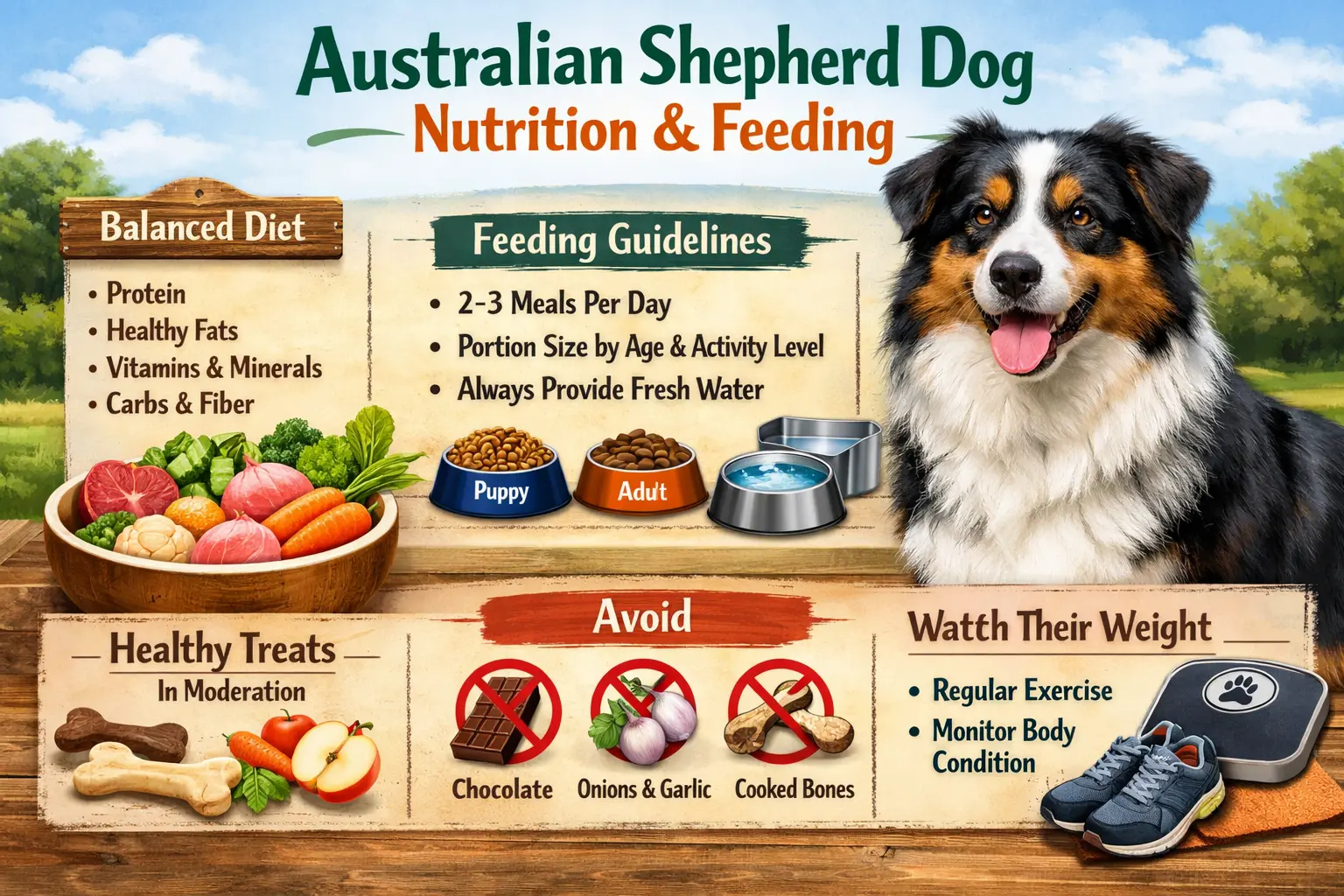
Feed a complete diet appropriate for life stage and expected adult size.
For growing puppies, discuss large-breed nutrition with your veterinarian. Controlled growth and a lean healthy body condition are particularly important when orthopedic risk is a concern.
For adults:
- measure food
- include treats in total calories
- feel for ribs under a light fat covering
- look for a visible waist
- adjust intake when activity changes
Do not use an internet “ideal weight” for the mix as a feeding target when the cross itself has no fixed standard.
Is this mix right for you?
It may suit you if you want:
- a smart, trainable companion
- a dog that enjoys active family life
- a hiking or walking partner
- a larger dog
- an animal that enjoys learning
- a dog you can groom regularly
It may be a poor fit if you want:
- minimal shedding
- very low exercise needs
- long periods of daily isolation
- completely predictable adult size
- a dog requiring little training
- a pet that stays comfortable outdoors in intense heat
What to ask before buying an Australian Shepherd Bernese Mountain Dog mix puppy
Do not choose only from photographs.
Ask:
- Why was this particular pairing chosen?
- What are the parents’ temperaments?
- Can I meet the mother and, if possible, the father?
- What verified health testing was done?
- What is the family history of cancer and longevity?
- How are puppies socialized?
- What surfaces, people, noises, and handling do they experience?
- At what age do puppies go home?
- Is there a written contract?
- Will the breeder take the dog back if the owner cannot keep it?
A thoughtful breeder should be comfortable with detailed questions and should ask you questions too.
Frequently asked questions
What is an Australian Bernese Mountain Dog?
The term generally refers to a cross between an Australian Shepherd and a Bernese Mountain Dog. Australian Mountain Dog and Aussie Bernese are other informal names.
How much does an Australian Shepherd Bernese Mountain Dog mix weigh?
There is no fixed standard. The parent breeds span roughly 40–115 pounds, so adult mixed dogs can vary substantially.
Are Aussie Bernese dogs high energy?
Many are moderate to high energy, especially when they inherit Australian Shepherd work drive. Daily physical activity plus mental stimulation is a sensible expectation.
Do Australian Shepherd Bernese mixes shed a lot?
Usually yes. Both parent breeds have double coats and shed.
Are they easy to train?
They are often intelligent and responsive, but intelligence also means they need consistency and mental engagement. Reward-based training is a strong fit for both parent influences.
Can an Aussie Bernese have blue eyes?
Yes. Eye-color traits from the Australian Shepherd side can appear, although brown eyes are also common.
Are Aussie Bernese dogs good for first-time owners?
They can be if the owner is prepared for training, exercise, grooming, and a potentially large adult. An inexperienced owner who wants a low-maintenance dog may find the mix demanding.
A note on sources and method
Because the Australian Shepherd Bernese Mountain Dog mix has no official breed standard or robust population dataset, size, lifespan, temperament, and health are not presented as fixed traits. Parent-breed measurements and characteristics were checked against current American Kennel Club information, with health considerations informed by parent-breed screening guidance. No individual veterinarian reviewed this draft.

Ata Ur Rehman is the founder of Pet Age in Human Years Calculator, an educational platform that provides age conversion charts and lifespan guides for dogs, cats, birds, and other companion animals. His work focuses on helping pet owners understand how animal ages translate into human years using commonly accepted age conversion formulas and published lifespan averages.
The website compiles breed and species lifespan data from kennel clubs, breed organizations, and general animal lifespan studies to present simple and easy-to-understand guides for pet owners worldwide.
This website was created to centralize animal age conversion charts into one easy reference platform for pet owners.
This article is for general education. For symptoms, medication, diet changes, or health concerns, use a qualified veterinarian who can assess your individual pet.