On this page
Many Chesapeake Bay Retriever owners want to know how their dog’s age compares to human years. While the old “1 dog year equals 7 human years” rule is still widely repeated, modern research shows that dogs age much differently.
Chesapeake Bay Retrievers mature rapidly during their first two years of life. After reaching adulthood, aging slows for a period before accelerating again during the senior years. Because this breed is considered a large dog, it generally ages faster later in life than smaller breeds.
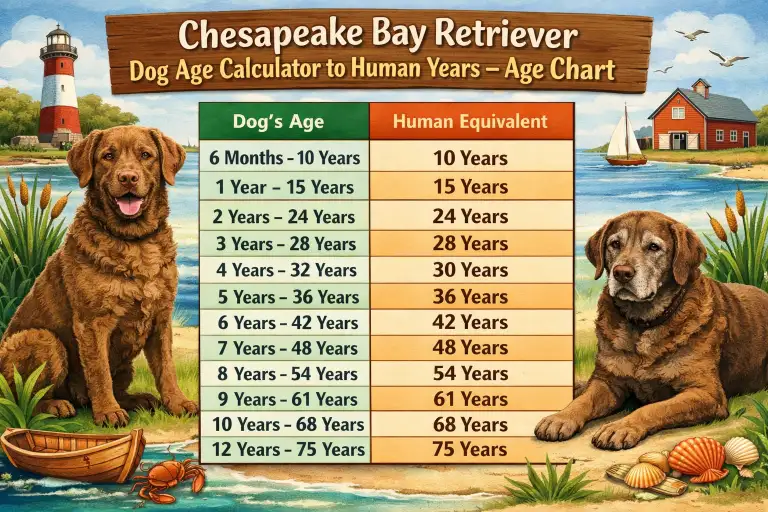
This Chesapeake Bay Retriever age chart provides a simple way to compare dog years to human years and better understand your dog’s life stage, aging process, and expected lifespan.
Why Chesapeake Bay Retrievers Age Differently
Several factors influence how quickly a Chesapeake Bay Retriever ages:
- Large-breed growth patterns
- Breed-specific lifespan characteristics
- Physical size and body weight
- Activity levels and overall health
- Modern canine aging research
For example, a 5-year-old Chesapeake Bay Retriever is typically comparable to a human in their late 30s, while a 10-year-old Chesapeake Bay Retriever may be similar to a human in their early 60s.
Chesapeake Bay Retriever Age Chart (Dog Years to Human Years)
Use the chart below to estimate your Chesapeake Bay Retriever’s human age equivalent.
| Dog Age (Years) | Human Age Equivalent | Life Stage |
|---|---|---|
| 1 | 15 | Puppy |
| 2 | 24 | Young Adult |
| 3 | 28 | Adult |
| 4 | 32 | Adult |
| 5 | 38 | Adult |
| 6 | 43 | Adult |
| 7 | 48 | Mature Adult |
| 8 | 53 | Senior |
| 9 | 58 | Senior |
| 10 | 63 | Senior |
| 11 | 68 | Senior |
| 12 | 73 | Senior |
| 13 | 78 | Senior |
Quick Age Conversion Examples
| Chesapeake Bay Retriever Age | Human Age Equivalent |
|---|---|
| 1 Year | 15 Years |
| 2 Years | 24 Years |
| 5 Years | 38 Years |
| 8 Years | 53 Years |
| 10 Years | 63 Years |
| 12 Years | 73 Years |
Important Notes
- Most Chesapeake Bay Retrievers live between 10 and 13 years.
- Individual dogs may age differently depending on genetics and health.
- Weight management can significantly impact lifespan.
- Activity levels often influence mobility and overall wellness later in life.
How Chesapeake Bay Retrievers Age Compared to Humans
Dogs do not age in a straight line.
The first two years of a Chesapeake Bay Retriever’s life represent the most rapid period of development. During this time, puppies grow physically, mentally, and emotionally much faster than humans.
After reaching adulthood, aging progresses more gradually. Once a Chesapeake Bay Retriever enters the senior stage, the aging process begins to accelerate again.
Typical Aging Pattern
- Rapid puppy development during the first two years
- Stable adult years between ages 3 and 6
- Noticeable slowing around ages 7 and 8
- Senior aging beginning around age 8
- Increased health monitoring recommended after age 9
Because Chesapeake Bay Retrievers are large, athletic working dogs, they often show age-related changes earlier than smaller breeds.
Chesapeake Bay Retriever Life Stages Explained
Understanding life stages helps owners provide the right care at every age.
| Dog Age | Life Stage | Typical Characteristics |
|---|---|---|
| 0–1 Year | Puppy | Rapid growth, learning, high energy |
| 1–2 Years | Adolescent | Physical development, increased independence |
| 3–6 Years | Adult | Peak fitness and working ability |
| 7–8 Years | Mature Adult | Slight decrease in activity levels |
| 9+ Years | Senior | Reduced mobility, increased rest, aging signs |
Signs Your Chesapeake Bay Retriever Is Entering the Senior Years
Many Chesapeake Bay Retrievers begin showing senior characteristics around age 8.
Common signs include:
- Slower movement
- Joint stiffness
- Increased sleeping
- Reduced stamina
- Weight gain
- Graying around the muzzle
- Longer recovery after exercise
These changes are a normal part of aging and often develop gradually.
Chesapeake Bay Retriever Lifespan and Life Expectancy
The average Chesapeake Bay Retriever lifespan is approximately 10 to 13 years.
Several factors can influence longevity:
| Factor | Potential Impact |
|---|---|
| Healthy Weight | Supports joint and heart health |
| Exercise | Helps maintain muscle mass and mobility |
| Nutrition | Supports overall wellness |
| Preventive Care | Early detection of health issues |
| Genetics | Influences lifespan and aging rate |
Dogs that maintain a healthy weight and receive consistent veterinary care often experience better quality of life during their senior years.
Helping Your Chesapeake Bay Retriever Age Healthily
While aging cannot be stopped, owners can help support healthy aging throughout every life stage.
| Life Stage | Main Focus | Recommended Care |
|---|---|---|
| Puppy | Growth | Balanced nutrition and controlled exercise |
| Adult | Fitness | Regular activity and weight management |
| Mature Adult | Prevention | Routine wellness checks and joint support |
| Senior | Comfort | Mobility support and adjusted exercise |
Healthy Aging Tips
- Maintain a healthy body weight.
- Provide daily physical activity.
- Schedule regular veterinary examinations.
- Watch for changes in movement or behavior.
- Support joint health as your dog ages.
- Keep your dog’s mind active through training and enrichment activities.
Even small lifestyle improvements can positively affect quality of life in later years.
Chesapeake Bay Retriever Age Chart vs Small, Medium, and Giant Breeds
Breed size has a major impact on aging.
| Breed Size | Typical Aging Speed |
|---|---|
| Small Dogs | Slowest aging after adulthood |
| Medium Dogs | Moderate aging |
| Large Dogs | Faster aging in senior years |
| Giant Dogs | Fastest aging overall |
Because Chesapeake Bay Retrievers fall into the large-breed category, they generally reach senior status sooner than many small breeds.
Frequently Asked Questions
How old is a 5-year-old Chesapeake Bay Retriever in human years?
A 5-year-old Chesapeake Bay Retriever is approximately 38 human years old according to modern dog aging models.
How old is a 10-year-old Chesapeake Bay Retriever in human years?
A 10-year-old Chesapeake Bay Retriever is roughly equivalent to a 63-year-old human.
What is the average lifespan of a Chesapeake Bay Retriever?
Most Chesapeake Bay Retrievers live between 10 and 13 years.
When is a Chesapeake Bay Retriever considered a senior?
Most Chesapeake Bay Retrievers are considered seniors at around 8 years of age.
Do Chesapeake Bay Retrievers age faster than small dogs?
Yes. Large breeds typically age faster during their later years than smaller breeds.
Is the 7 dog years rule accurate?
No. Modern research shows dog aging is not linear. Dogs age rapidly in their early years and more gradually during adulthood.
Final Thoughts
A Chesapeake Bay Retriever’s age cannot be accurately measured using the old 7-to-1 rule. Like most large breeds, Chesapeake Bay Retrievers mature quickly, experience a stable adult period, and then age more rapidly during their senior years.
Using a Chesapeake Bay Retriever age chart helps owners better understand their dog’s life stage, health needs, and human age equivalent. Whether your dog is a playful puppy, a strong adult, or a beloved senior companion, understanding the aging process can help you provide the right care at every stage of life.

Ata Ur Rehman is the founder of Pet Age in Human Years Calculator, an educational platform that provides age conversion charts and lifespan guides for dogs, cats, birds, and other companion animals. His work focuses on helping pet owners understand how animal ages translate into human years using commonly accepted age conversion formulas and published lifespan averages.
The website compiles breed and species lifespan data from kennel clubs, breed organizations, and general animal lifespan studies to present simple and easy-to-understand guides for pet owners worldwide.
This website was created to centralize animal age conversion charts into one easy reference platform for pet owners.
This article is for general education. For symptoms, medication, diet changes, or health concerns, use a qualified veterinarian who can assess your individual pet.