On this page
Most people have heard the old rule that one dog year equals seven human years. While simple, this rule is not accurate for most breeds, including Pointer dogs. Pointers grow and mature much faster during their first years of life and then age more gradually throughout adulthood.
Understanding your Pointer’s age in human years helps you better recognize life stages, anticipate health needs, and provide age-appropriate care. Whether you have a young Pointer puppy or a senior companion, this age chart can help you understand where your dog is in its life journey.
If you want an exact age conversion, use our Pointer Dog Age Calculator for a personalized estimate. This age chart provides a quick reference based on typical Pointer development and lifespan patterns.
Why the 7 Dog Years Rule Is Inaccurate
The traditional 7-to-1 rule assumes dogs age at a constant rate throughout their lives. In reality, dogs mature rapidly during puppyhood and adolescence and then age more slowly as adults.
| Pointer Age | 7-Year Rule Result | More Accurate Human Age |
|---|---|---|
| 1 Year | 7 Years | ~30 Years |
| 3 Years | 21 Years | ~36 Years |
| 5 Years | 35 Years | ~43 Years |
| 10 Years | 70 Years | ~67 Years |
The biggest problem with the old rule is that it underestimates how quickly young dogs mature and overestimates aging in later life.
For Pointer owners, this is particularly important because the breed often remains energetic and athletic well into middle age.
The Science Behind Pointer Aging
Pointers are medium-to-large sporting dogs known for their athleticism, endurance, and active lifestyles. Like many breeds of similar size, they experience rapid development during their first two years.
Scientists now recognize that dog aging follows a non-linear pattern. Growth and development occur very quickly during puppyhood, while aging slows considerably after adulthood.
Several factors influence how a Pointer ages:
| Factor | Impact on Aging |
|---|---|
| Genetics | Influences lifespan and health outcomes |
| Body Size | Larger dogs generally age faster |
| Exercise | Supports healthy aging and mobility |
| Nutrition | Helps maintain healthy weight and organ function |
| Preventive Care | Early detection of age-related issues |
Because Pointers are active working dogs, maintaining a healthy weight and exercise routine plays an important role in healthy aging.
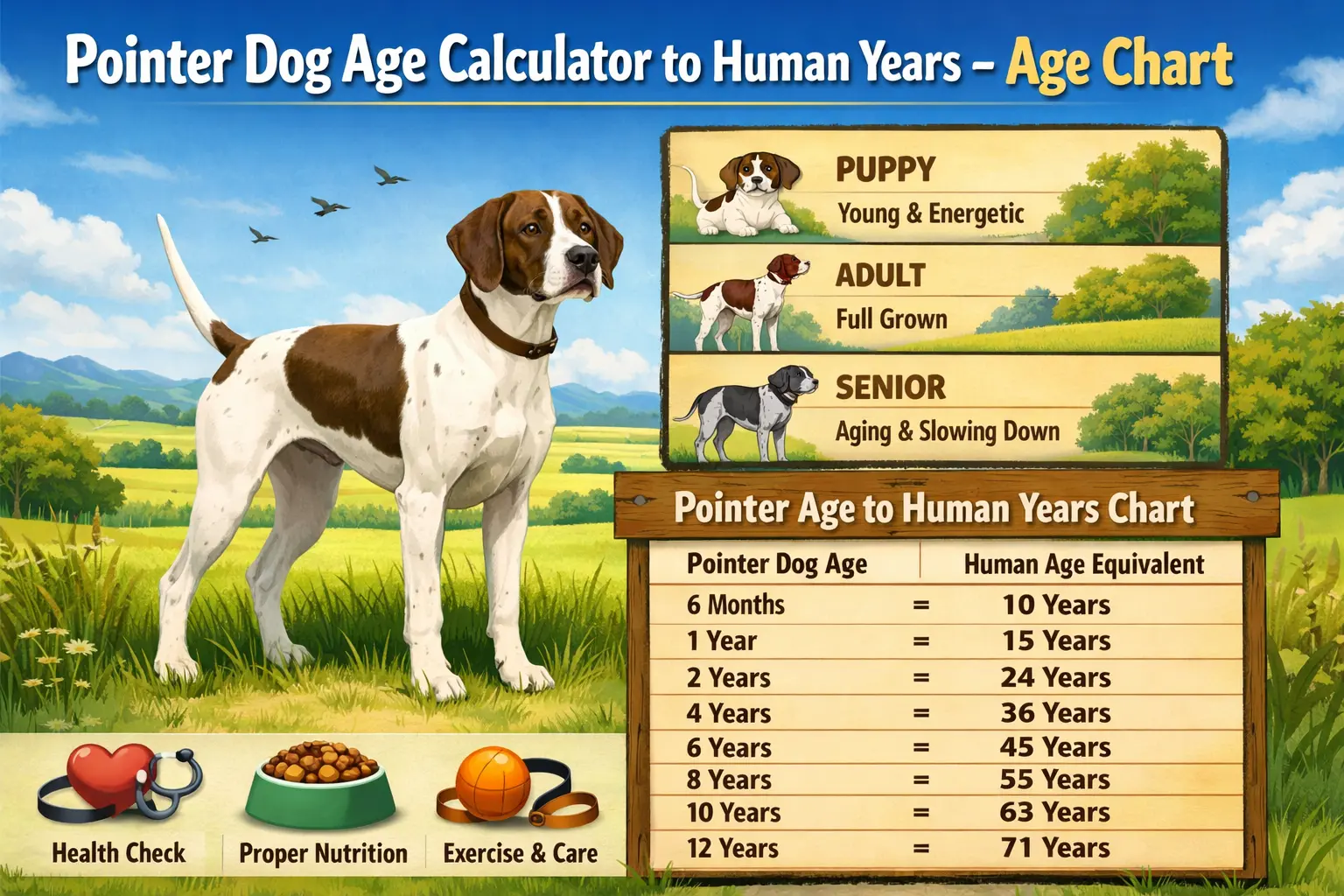
Pointer Dog Age to Human Years Chart
The following chart provides estimated human age equivalents for Pointer dogs.
| Pointer Age | Human Age Equivalent | Life Stage |
|---|---|---|
| 6 Months | ~15 Years | Puppy |
| 1 Year | ~30 Years | Young Adult |
| 2 Years | ~35 Years | Adult |
| 3 Years | ~38 Years | Adult |
| 4 Years | ~41 Years | Adult |
| 5 Years | ~44 Years | Adult |
| 6 Years | ~47 Years | Mature Adult |
| 7 Years | ~51 Years | Mature Adult |
| 8 Years | ~55 Years | Early Senior |
| 9 Years | ~60 Years | Senior |
| 10 Years | ~67 Years | Senior |
| 11 Years | ~70 Years | Senior |
| 12 Years | ~73 Years | Senior |
| 13 Years | ~76 Years | Very Senior |
| 14 Years | ~79 Years | Very Senior |
These values represent averages and should be used as estimates rather than exact biological equivalents.
Pointer Life Stages Explained
Puppy Stage (0–12 Months)
During the first year, Pointers experience extremely rapid physical and mental development. Training, socialization, and nutrition are particularly important during this stage.
Young Adult Stage (1–2 Years)
Most Pointers reach physical maturity between one and two years of age. Energy levels remain high, and many dogs enter their peak athletic years.
Adult Stage (2–6 Years)
This is typically the healthiest and most active period of a Pointer’s life. Regular exercise and preventive veterinary care help maintain long-term health.
Mature Adult Stage (6–8 Years)
You may notice slightly reduced stamina and longer recovery times after intense activity. Weight management becomes increasingly important.
Senior Stage (8+ Years)
Senior Pointers may develop age-related changes such as joint stiffness, reduced mobility, hearing loss, or vision changes. Regular veterinary checkups become increasingly valuable.
Pointer Age Compared to Other Dog Sizes
Pointers generally age more slowly than giant breeds but somewhat faster than many small dog breeds.
| Dog Size | Average Lifespan | Relative Aging Speed |
|---|---|---|
| Small Breeds | 12–16 Years | Slower |
| Medium Breeds | 11–15 Years | Moderate |
| Pointer Dogs | 12–15 Years | Moderate |
| Large Breeds | 10–13 Years | Faster |
| Giant Breeds | 7–10 Years | Fastest |
This explains why a Pointer’s age conversion differs from both toy breeds and giant breeds.
Signs Your Pointer Is Entering Senior Years
As Pointers age, owners may notice:
- Reduced endurance during exercise
- Longer recovery times
- Gray hair around the muzzle
- Increased sleeping
- Joint stiffness
- Weight changes
- Vision or hearing decline
These changes often develop gradually over several years.
Helping Your Pointer Age Well
Healthy aging involves more than simply counting years.
| Area | Recommendation |
|---|---|
| Nutrition | Maintain a healthy weight |
| Exercise | Continue daily activity appropriate for age |
| Veterinary Care | Schedule routine wellness exams |
| Mobility | Monitor joints and flexibility |
| Mental Stimulation | Provide training, games, and enrichment |
| Environment | Create comfortable resting spaces |
Small lifestyle adjustments can significantly improve quality of life during senior years.
Frequently Asked Questions
How old is a 1-year-old Pointer in human years?
A 1-year-old Pointer is approximately equal to a 30-year-old human because dogs mature very rapidly during their first year.
How old is a 10-year-old Pointer in human years?
A 10-year-old Pointer is approximately 65–70 human years old depending on overall health and individual aging patterns.
At what age is a Pointer considered a senior?
Most Pointers begin entering their senior years around 8 years of age.
How long do Pointer dogs usually live?
Pointers typically live between 12 and 15 years when provided with proper care, nutrition, and veterinary attention.
Is the Pointer age chart exact?
No. Age charts provide estimates based on breed size, lifespan data, and typical aging patterns. Individual dogs may age differently.
Should I use an age chart or a calculator?
An age chart is useful for quick reference, while a breed-specific calculator can provide a more precise age conversion estimate.
Final Thoughts
Understanding your Pointer’s age in human years provides valuable insight into your dog’s development, health, and changing care needs. While no age chart can perfectly predict biological aging, it offers a practical way to understand where your Pointer falls within its life journey.
By combining age awareness with proper nutrition, exercise, preventive veterinary care, and regular monitoring, you can help your Pointer enjoy a healthier and more comfortable life at every stage.

Ata Ur Rehman is the founder of Pet Age in Human Years Calculator, an educational platform that provides age conversion charts and lifespan guides for dogs, cats, birds, and other companion animals. His work focuses on helping pet owners understand how animal ages translate into human years using commonly accepted age conversion formulas and published lifespan averages.
The website compiles breed and species lifespan data from kennel clubs, breed organizations, and general animal lifespan studies to present simple and easy-to-understand guides for pet owners worldwide.
This website was created to centralize animal age conversion charts into one easy reference platform for pet owners.
This article is for general education. For symptoms, medication, diet changes, or health concerns, use a qualified veterinarian who can assess your individual pet.