On this page
Scottish Terrier training methods work best when they match the breed’s independent, alert, and strong-willed personality. A Scottie is not usually a dog that obeys because you repeat a command louder. This breed responds better to short sessions, clear expectations, high-value rewards, and calm consistency.
Many owners look for Scottish Terrier training tips after realizing that generic dog training advice does not always work well with this breed. What looks like stubbornness is often selective decision-making. Scottish Terriers can learn quickly, but they may lose interest if training feels repetitive, harsh, or pointless to them.
This guide explains how to train a Scottish Terrier using practical methods for puppies and adults. It covers house training, obedience, leash manners, recall, barking control, impulse control, and common Scottie behavior problems. If you also want to understand how your Scottie’s age compares to human years, use the Scottish Terrier Dog Age Calculator.
Quick Answer: Are Scottish Terriers Hard to Train?
Scottish Terriers are not impossible to train, but they can be challenging for owners who expect instant obedience. They are intelligent, independent, and easily bored by repeated commands. The best approach is reward-based training, short daily sessions, early leash control, strong recall practice, and calm redirection instead of punishment.
Why Scottish Terrier Training Methods Must Match the Breed’s Temperament
Scottish Terriers were bred to be confident, bold, and self-directed. That independence is part of the breed’s charm, but it also means training must feel purposeful. A Scottie may ignore commands if the reward is weak, the session is too long, or the owner is inconsistent.
The most effective Scottish Terrier training methods focus on motivation, structure, and repetition without pressure. This breed often responds well to food rewards, praise, short games, and a clear routine. Harsh corrections usually create resistance, stress, or avoidance, especially in sensitive dogs.
Because Scottish Terriers can have a strong prey drive, training should also include recall, leash manners, and impulse control. These skills are not just obedience goals; they help keep your Scottie safe around small animals, traffic, guests, and unfamiliar environments.
Scottish Terrier Traits vs Training Implications
| Trait | What It Means for Training | Best Owner Response |
|---|---|---|
| Independent | May not obey unless the task feels worthwhile | Use high-value rewards and clear commands |
| Intelligent | Learns quickly but gets bored with repetition | Keep sessions short, varied, and focused |
| Strong-willed | May resist pressure or forced handling | Use calm consistency instead of punishment |
| Prey driven | May chase small animals or moving objects | Practice recall, leash control, and impulse control early |
| Alert | May bark at sounds, strangers, or movement | Reward calm behavior and teach a reliable “quiet” cue |
Understanding Scottish Terrier Behavior Before Training
Before starting obedience work, it helps to understand what motivates a Scottish Terrier. Scotties usually respond best when training is calm, rewarding, and predictable. They do not need endless repetition; they need clear signals and a reason to cooperate.
Puppies are usually more curious and easier to shape through early routines, while adult Scottish Terriers may need more patience if they have already developed habits like pulling, barking, guarding, or ignoring commands. Both can improve with consistent training, but the method must fit the dog’s age, confidence level, and daily routine.
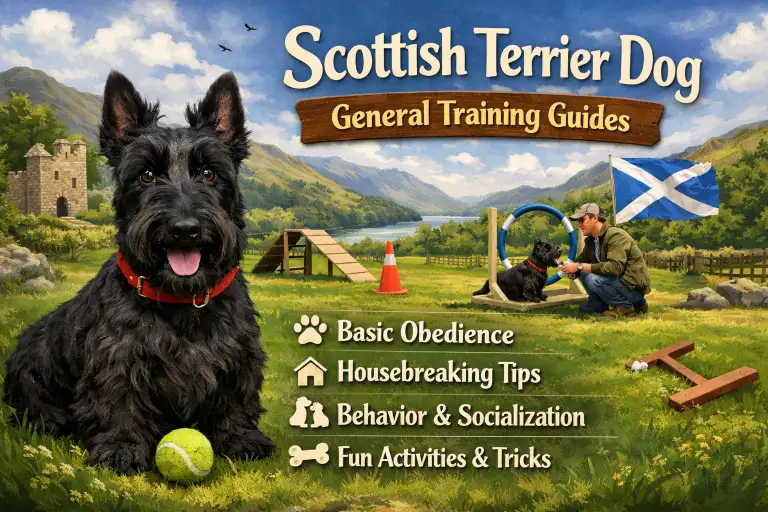
Good Scottish Terrier training should focus on six core areas: reward-based obedience, house training, leash manners, recall, barking control, and impulse control. These skills create a foundation for better behavior at home and in public.
Common Scottish Terrier Behaviors & What They Mean
| Behavior | What It Usually Means | How to Respond |
|---|---|---|
| Ignoring commands | The reward is weak, the cue is unclear, or the dog is distracted | Use better rewards, reduce distractions, and reward fast responses |
| Barking at strangers | Alert behavior or protective instinct | Teach “quiet,” reward calm watching, and avoid yelling |
| Chasing small animals | Prey drive | Use a leash, practice recall, and build impulse control |
| Stopping training early | Boredom, frustration, or session fatigue | Keep sessions short and end before the dog disengages |
| Guarding food or toys | Resource protection | Use trade games and reward calm sharing behavior |
Step-by-Step Scottish Terrier Training Methods for Puppies and Adults
The best way to train a Scottish Terrier is to build one skill at a time. Start in a quiet area, use a reward your dog genuinely wants, and practice for a few minutes before the dog loses interest. Short, successful sessions are more effective than long sessions that end in frustration.
Begin with simple commands such as sit, stay, come, leave it, and leash walking. Once your Scottie understands the cue indoors, repeat it in slightly more distracting places. This helps your dog learn that commands apply everywhere, not only in the kitchen or living room.
For Scottish Terrier puppy training, focus first on house training, crate comfort, name response, socialization, and gentle leash practice. For adult Scotties, focus on correcting existing habits, improving recall, reducing barking, and building reliable obedience through consistency.
Scottish Terrier Training Schedule: Puppy vs Adult
| Age | Session Length | Sessions per Day | Main Training Focus |
|---|---|---|---|
| Puppy: 8-16 weeks | 5-10 minutes | 2-3 | Name response, potty training, crate training, gentle handling, early socialization |
| Puppy: 4-6 months | 10-15 minutes | 2 | Basic obedience, recall, leash manners, sit, stay, leave it |
| Young adult | 10-15 minutes | 1-2 | Impulse control, barking control, recall around distractions, polite walking |
| Adult Scottie | 10-15 minutes | 1-2 | Correcting bad habits, reinforcing obedience, confidence building, calm behavior |
Training Do’s and Don’ts for Scottish Terriers
| Do | Don’t |
|---|---|
| Use treats, praise, toys, or short games as rewards | Use yelling, intimidation, or harsh punishment |
| Keep sessions short and end on success | Repeat commands until your dog ignores them |
| Train one skill at a time | Teach too many commands in one session |
| Practice in different rooms and outdoor spaces | Expect perfect behavior in new places immediately |
| Reward calm choices and fast responses | Ignore early signs of stress, boredom, or frustration |
Common Scottish Terrier Training Problems and Solutions
Scottish Terrier behavior problems usually become worse when training is inconsistent. Common issues include ignoring commands, pulling on the leash, barking too much, guarding items, chasing animals, and refusing recall. These behaviors are manageable, but they need a clear training plan.
If your Scottie ignores commands, do not keep repeating the same cue. Go back to a quieter environment, use a better reward, and make the task easier. If your dog pulls on the leash, stop moving forward when the leash tightens and reward walking beside you. If barking becomes a habit, reward quiet behavior before the barking escalates.
The goal is not to remove the Scottish Terrier’s personality. The goal is to teach your Scottie when to listen, how to settle, and which behaviors earn rewards.
Scottish Terrier Training Problems, Causes, and Fixes
| Problem | Likely Cause | Best Training Fix |
|---|---|---|
| Ignoring commands | Distraction, unclear cue, or low motivation | Use better rewards, reduce distractions, and reward quick responses |
| Leash pulling | Excitement, prey drive, or habit | Use stop-and-go walking, reward loose leash movement, and practice daily |
| Excessive barking | Alert behavior, boredom, or frustration | Teach “quiet,” reward calm behavior, and reduce triggers where possible |
| Guarding food or toys | Resource protection | Use trade games, avoid grabbing items, and reward relaxed sharing |
| Chasing animals | Prey drive | Practice recall, use leash control, and teach “leave it” around movement |
| Potty accidents | Weak routine or too much freedom too soon | Use scheduled bathroom breaks, crate training, and immediate rewards outside |
More Scottish Terrier Resources
Use these related Scottish Terrier resources for topics that are covered in more detail on their dedicated pages:
- Scottish Terrier Dog Breed Guide
- Scottish Terrier Age Chart
- Scottish Terrier Grooming Guide
- Scottish Terrier Nutrition and Feeding Guide
- Scottish Terrier Cost of Ownership Guide

Ata Ur Rehman is the founder of Pet Age in Human Years Calculator, an educational platform that provides age conversion charts and lifespan guides for dogs, cats, birds, and other companion animals. His work focuses on helping pet owners understand how animal ages translate into human years using commonly accepted age conversion formulas and published lifespan averages.
The website compiles breed and species lifespan data from kennel clubs, breed organizations, and general animal lifespan studies to present simple and easy-to-understand guides for pet owners worldwide.
This website was created to centralize animal age conversion charts into one easy reference platform for pet owners.
This article is for general education. For symptoms, medication, diet changes, or health concerns, use a qualified veterinarian who can assess your individual pet.